Batteries are often presented as the missing link in a low-carbon energy system: store renewable electricity when it is available, release it when needed, electrify transport, and reduce dependence on combustion. The basic idea is sound. Electrochemical storage is modular, fast-responding, efficient enough for many applications, and already indispensable in portable electronics and electric vehicles.
The difficulty is that “battery breakthrough” is an overloaded phrase. In microelectronics, performance improvements were historically associated with rapid scaling: smaller transistors, denser integrated circuits, lower cost per function, and predictable product cycles. Batteries do not scale in the same way. They depend on bulk chemical reactions, ion transport, phase changes, separators, electrolytes, current collectors, safety margins, thermal paths, and manufacturing yield. A better electrode material on a laboratory coupon is not the same thing as a qualified cell, and a qualified cell is not the same thing as a durable, safe, cost-effective battery pack.
Lithium-ion is the best example of real progress without a single miracle event. According to the supplied Battery University reference, lithium-ion capacity improved by about 8% per year over the last two decades and that rate has slowed to roughly 5% per year. Those figures are modest compared with semiconductor expectations, but they are large enough to transform products over time. The smartphone, cordless tool, laptop, e-bike, and modern EV all depend on cumulative improvements in cell chemistry, electrode loading, separator quality, electrolyte additives, formation control, battery management, and pack integration.
Cost has also fallen substantially over the years as production volume increased and manufacturing became more disciplined. The supplied evidence supports the direction of that change but does not provide a verified universal annual cost-reduction percentage. That matters because battery cost is not one number. It varies by chemistry, format, production region, material contract, pack design, safety system, warranty requirement, and application. A cell sold for consumer electronics is not costed the same way as a traction pack designed for automotive crash, vibration, thermal, and lifetime requirements.
A useful way to judge breakthrough claims is to separate cell-level promise from system-level value. Higher specific energy is helpful only if the cell can also meet requirements for cycle life, calendar life, abuse tolerance, rate capability, manufacturability, raw-material availability, and cost. A chemistry that looks exceptional in watt-hours per kilogram may fail because it swells, forms metallic deposits, consumes electrolyte, corrodes hardware, requires dry-room processing beyond economic limits, or cannot be produced with acceptable yield.
The main families often described as “next-generation” batteries address different parts of the problem:
| Technology | Main attraction | Main unresolved engineering issue |
|---|---|---|
| Improved lithium-ion | Incremental gains using existing manufacturing base | Slower annual capacity growth and dependence on mature chemistries |
| Lithium-air | Very high theoretical energy potential | Stability and reversibility of the electrochemical system |
| Lithium-metal | Higher anode capacity than graphite | Dendrite growth, low practical efficiency, and safety control |
| Lithium-sulfur | Potentially high energy with sulfur cathodes | Commercialization remains difficult; full-cell durability must be proven |
| Redox-flow | Decoupled energy and power for stationary storage | Electrolyte/material compatibility, corrosion, system complexity |
| Graphene-enhanced cells | Better conductivity, possible energy and rate improvements | Scalable, consistent, low-cost graphene integration |
Lithium-air attracts attention because oxygen from air appears to offer a path to much higher energy than conventional intercalation electrodes. In principle, not carrying one of the reactants inside the cell is attractive. In practice, lithium-air is not simply a lithium-ion cell with an air inlet. The chemistry must manage oxygen reactions, discharge products, electrolyte stability, cathode clogging, moisture and carbon dioxide sensitivity, recharge efficiency, and long-term reversibility. The supplied research identifies stability as a central issue. Until that stability is solved in practical cells, lithium-air remains more of a research direction than a near-term replacement for conventional lithium-ion.
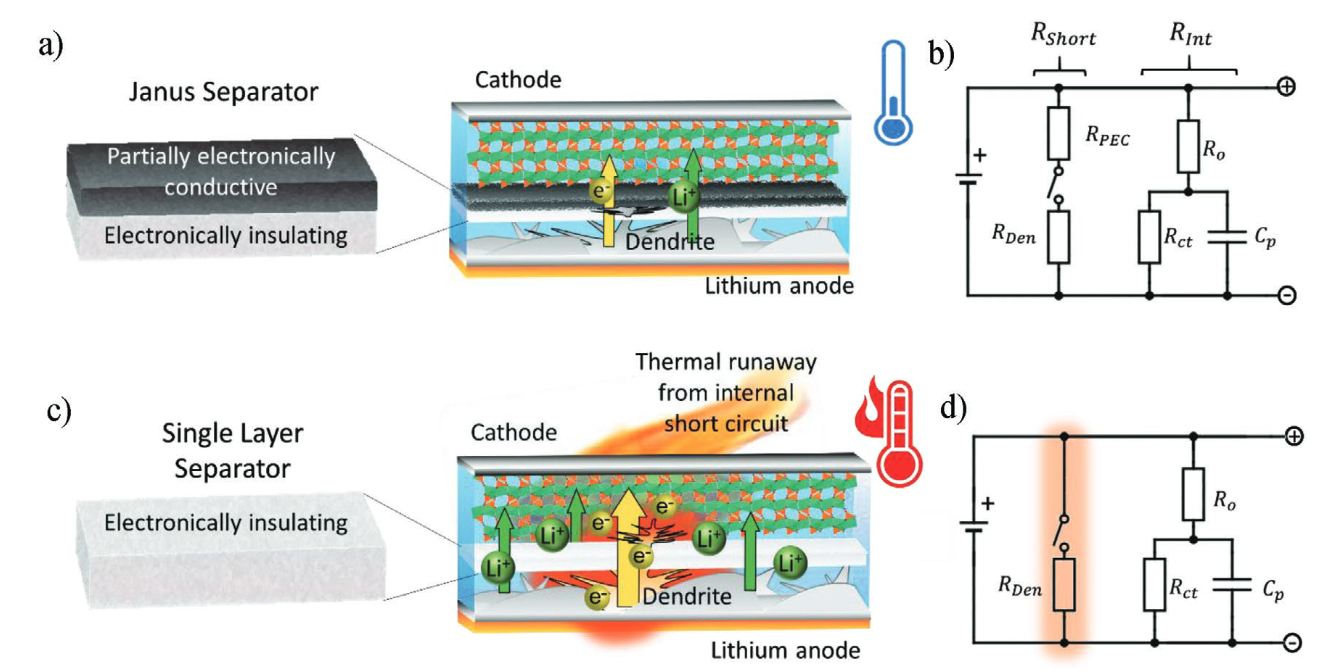
Lithium-metal is more immediately relevant because it can be used as an anode concept in several advanced systems, including some solid-state and lithium-sulfur designs. Metallic lithium offers much higher theoretical capacity than graphite, but it also creates one of the most persistent failure modes in rechargeable batteries: dendrite formation. During repeated plating and stripping, lithium can deposit unevenly. Microscopic metallic structures can grow through the electrolyte or separator region. If they bridge the electrodes, the cell can short-circuit, overheat, and in severe cases ignite. The supplied research notes that multiple groups have made progress toward dendrite-free lithium morphology and high coulombic efficiency, but also states that further breakthroughs are needed to push long-term efficiency and engineering relevance.
Source: Original source

This is why lithium-metal claims should be read carefully. “Dendrite-free” in a controlled laboratory cell at limited capacity loading is not automatically the same as dendrite-free in a large-format cell after years of cycling, fast charging, vibration, manufacturing variation, and temperature extremes. The problem is not only whether a dendrite appears in an image; it is whether the full cell maintains high coulombic efficiency, low impedance growth, mechanical integrity, and safety margin over the application’s required life.
Lithium-sulfur is another recurring candidate. Sulfur is attractive as a cathode material because it is relatively abundant and can support high theoretical energy. Commercialization, however, has been difficult. The supplied outline requires lithium-sulfur to be treated as an advanced technology with unresolved commercial status rather than as an already established replacement. The issue is not whether lithium-sulfur cells can be demonstrated; they can. The harder question is whether they can deliver a combination of cycle life, calendar life, practical energy density, charge rate, safety, and production cost that beats incumbent lithium-ion in real applications.
Redox-flow batteries solve a different problem. Instead of storing energy in solid electrodes inside a sealed cell stack, they store active materials in liquid electrolytes held in external tanks and pumped through an electrochemical stack. This allows energy capacity to be increased by enlarging the tanks, while power is governed mainly by stack size. That architecture is attractive for stationary storage where weight and volume are less critical than lifetime, serviceability, and the ability to size energy and power independently.
The tradeoff is that a redox-flow battery is more like a chemical plant than a sealed portable cell. Pumps, tanks, piping, valves, seals, sensors, and electrolyte management are part of the battery. The supplied research specifically flags corrosion issues. Corrosion and material compatibility matter because the electrolyte is continuously circulated through system hardware. A stationary battery can tolerate mass and volume that would be unacceptable in a vehicle, but it still has to justify its capital cost, maintenance burden, round-trip efficiency, footprint, and operating reliability.
Graphene is often presented as a battery accelerator because of its high electrical conductivity, large surface area, mechanical strength, and thermal properties. The supplied research describes graphene as a material being investigated for enhanced lithium-ion batteries, lithium-sulfur systems, supercapacitor-like devices, and improved thermal and rate behavior. It also specifically calls out graphene coating on anodes as a route to improved energy density.
The engineering logic is plausible. A conductive graphene-containing coating can improve electron transport, help stabilize active material surfaces, and support electrode structures that otherwise suffer from poor conductivity or mechanical degradation. In some concepts, graphene is used with silicon-rich anodes, sulfur cathodes, or composite electrodes. The evidence supplied here supports the general claim that graphene may improve energy density, charging speed, cycle life, and thermal behavior, but it does not support a specific guaranteed percentage increase for anode coating. Any article claiming a precise energy-density gain should identify the cell format, loading, test protocol, cycle count, and comparison baseline.
Commercialization timelines for emerging batteries are therefore uncertain. The supplied sources include market-oriented claims for graphene battery growth and research activity, but market growth is not the same as technical displacement of lithium-ion. A new material can enter niche products before it is ready for automotive traction packs or grid infrastructure. Automotive cells must pass qualification regimes, abuse testing, quality audits, and warranty analysis. Grid systems must satisfy bankability, fire protection, serviceability, and long-duration operating requirements. A five-year research plan can produce important science without producing a universal commercial battery.
The Joint Center for Energy Storage Research, or JCESR, illustrates a structured response to this problem. The supplied Department of Energy information describes JCESR as a multi-institutional research team led by Argonne National Laboratory, with participation from other national laboratories, universities, and industrial partners. Its initial 2013–2018 award focused on electrochemistry and materials challenges for systems beyond lithium-ion, including atomic-level understanding of reaction pathways and design rules for electrolyte and electrode function. The supplied material also notes that JCESR used technoeconomic modeling to guide fundamental research priorities.
That technoeconomic element is important. Battery research can otherwise optimize the wrong variable. A chemistry with outstanding laboratory energy density may require scarce materials, expensive purification, low-yield processing, or pack-level controls that erase the advantage. JCESR’s well-known “5-5-5” framing set an aggressive direction: far better storage performance, much lower cost, and a five-year development horizon. Such targets are useful for organizing research, but they should not be read as a guarantee that every targeted chemistry will become a commercial product on schedule.
Toyota’s Sakichi battery initiative is a historical reminder that the desire for a transformative storage battery is not new. Sakichi Toyoda, associated with the roots of the Toyota industrial group, promoted a battery prize intended to stimulate a major leap in electric storage. The exact technical conditions and prize details are not verified in the supplied web excerpts, so they should not be overstated here. The relevant engineering lesson is clear enough: industry has been looking for a compact, powerful, durable storage device for nearly a century, and the underlying challenge has remained difficult despite enormous progress.
Consumer electronics show where batteries work well. A smartphone or laptop battery does not need to move a two-ton vehicle hundreds of kilometers, pull freight, or provide emergency grid reserve for many hours. Its duty cycle is demanding but bounded. Users often accept daily charging, gradual capacity fade, and device replacement after several years. In that environment, lithium-ion’s combination of energy density, manufacturability, and acceptable safety has been highly successful. Many consumers are dissatisfied when devices age or charging is inconvenient, but modern portable electronics would not be practical at their present size and capability without lithium-ion.
Electric vehicles impose a harder requirement. The battery must provide high energy, high power, fast charge acceptance, cold and hot temperature performance, crash safety, long calendar life, long cycle life, and low cost. It must also be packaged into a structural vehicle environment with cooling, isolation monitoring, fusing, contactors, enclosure sealing, and software controls. A single weak cell does not remain a cell-level issue; it affects module and pack reliability. The EV battery is therefore not just a chemistry choice but an integrated electrochemical, thermal, mechanical, electrical, and control system.
This is why energy density comparisons with fossil fuels can be misleading but still useful. Liquid fuels have very high specific energy at the fuel level, while batteries store much less energy per kilogram. Electric drivetrains are more efficient than combustion drivetrains, so the comparison is not one-to-one. Even after accounting for efficiency, however, batteries remain heavier and slower to replenish than liquid fuels in many long-range, high-duty applications. Passenger EVs can work well because the duty cycle, charging infrastructure, regenerative braking, and drivetrain efficiency align with battery strengths. Heavy transport, aircraft, and long-distance rail are less forgiving.
Trains can use batteries for short routes, hybridization, depot movements, regenerative capture, or operation on unelectrified gaps. For high-utilization long-haul service, overhead electrification, onboard fuel, or other infrastructure may be more practical depending on route and economics. Aircraft are even more constrained because every kilogram affects lift, range, and reserve requirements. Batteries can support small aircraft, drones, ground operations, and auxiliary systems, but large passenger aircraft require energy density and recharge logistics far beyond what conventional battery packs presently provide. The supplied evidence supports the general limitation of batteries in large transportation but does not provide exact fuel-versus-battery numerical ratios, so none are asserted here.
The practical conclusion is not that battery breakthroughs are false. Some are real, but most are incremental, chemistry-specific, and application-dependent. A breakthrough in separator coating may be commercially more important than a spectacular but unstable laboratory chemistry. A modest improvement in cycle life can be decisive for grid economics. A small reduction in impedance growth can enable faster charging. A safer electrolyte can simplify pack protection. Battery progress often arrives as a stack of improvements rather than a single headline event.
A disciplined reading of battery news should ask several questions:
- Is the claim based on a material sample, coin cell, pouch cell, production-format cell, module, or full pack?
- Are energy density figures reported at electrode, cell, or pack level?
- Are cycle-life results shown at realistic depth of discharge, temperature, pressure, and charge rate?
- Is coulombic efficiency high enough for long-term rechargeable operation?
- Are safety tests, abuse tolerance, and failure modes discussed?
- Does the design require scarce materials, exotic manufacturing, or unusually tight environmental controls?
- Is the comparison made against current commercial cells or against an outdated baseline?
For engineers, fleet planners, product designers, and energy-storage buyers, the safest position is to treat batteries as a rapidly improving but physically constrained technology. Lithium-ion will likely continue to advance in steps, not leaps. Lithium-metal, lithium-sulfur, lithium-air, redox-flow, and graphene-enhanced systems may each find roles where their strengths match the duty cycle. None should be accepted as universal solutions without cell data, system data, safety evidence, and manufacturing evidence.
Battery breakthroughs are therefore neither pure myth nor guaranteed fact. They are hypotheses until proven at scale. The strongest claims become credible only when they survive the transition from promising chemistry to repeatable cell, from repeatable cell to managed pack, and from managed pack to fielded system with acceptable cost, safety, and lifetime.
References
- BU-103a: Battery Breakthroughs: Myth or Fact?
- Graphene Battery Advancements in Energy Density Improvements
- Lithium-metal Batteries via Suppressing Li Dendrite Growth …
- Graphene Batteries: Market Trends and Growth Potential
- Roots of the Lithium Battery Problem: Berkeley Lab Researchers Find Dendrites Start Below the Surface - Berkeley Lab – Berkeley Lab News Center
- Dendrites in batteries: The invisible danger
- Graphene battery as a viable alternative in electric vehicles for enhanced charging efficiency and thermal management
- How Graphene Batteries Are Disrupting Energy Storage
- Lithium-Metal Batteries & the Battle Against Dendrite Growth
- [PDF] Science/Basic Energy Sciences FY 2019 Congressional Budget …