Battery diagnostics should accompany the battery through its entire life cycle: research and development, manufacturing, deployment, service, reuse, and recycling. A battery may appear to work normally while its ability to deliver energy or power has already declined, so operational decisions should be based on measured condition rather than appearance or age alone.
Capacity is one of the most useful general indicators of battery health because it describes how much charge, and therefore usually how much usable energy, remains available. It is not the only relevant property. Power capability, internal resistance or impedance, temperature behavior, voltage response, charge history, and operating conditions can all affect whether a battery is suitable for a particular application.
Laboratory diagnostics can provide detailed information under controlled conditions, but field-aged batteries are often tested by service personnel who need a practical, portable, and reasonably fast method. Electrochemical impedance spectroscopy (EIS) is a promising approach because it characterizes electrical response across a range of conditions and can compare measurements with reference data or models. However, EIS is not a universal answer. Its usefulness depends on the battery chemistry, construction, age, temperature, state of charge, operating history, and measurement protocol.
Battery Diagnostic Methods: From Basic Tests to EIS
A useful way to organize battery tests is as a diagnostic pyramid. The methods near the base are generally simpler and faster, but they provide less information about the internal condition of the battery. More advanced methods can separate or estimate additional degradation indicators, but they require better instrumentation, validated data, and more technical expertise.
Source: Battery University
The four methods below are not interchangeable. Each answers a different question, and the correct choice depends on the application and the decision that the test must support.
- Load testing
A load test applies a defined electrical load and observes whether the battery can maintain voltage and deliver current. This is useful when the main question concerns power delivery. For example, a test of a starting battery may indicate whether it can provide the high current required for engine cranking without excessive voltage collapse.
Load testing is comparatively direct and can be practical in service environments. It can reveal weak batteries that perform acceptably at rest but fail when current is demanded. The result, however, should not be treated as a complete measurement of total capacity. A battery may pass a short high-current test and still have insufficient capacity for sustained runtime. Conversely, a battery intended for a low-current energy-storage application may require a different test profile from a starter battery.
The test itself also affects the interpretation. Load magnitude, duration, starting state of charge, temperature, and the battery’s rated application all matter. A result is meaningful only when the test conditions and acceptance criteria correspond to the equipment in which the battery will operate.
- Dynamic-response testing
Dynamic-response methods examine how voltage changes during a load pulse and how it recovers when the load is removed. The response can provide information about polarization, resistance, and other time-dependent effects that are not visible in a simple open-circuit voltage measurement.
For some lithium-ion batteries, rapid voltage recovery can be associated with relatively unrestricted ion transport and good condition. That relationship is useful, but it is not universal. Voltage recovery is influenced by chemistry, cell design, temperature, state of charge, current level, rest time, and the degradation mechanism. Two batteries with different designs may show different responses even when their remaining capacity is similar. A response measured at one temperature or state of charge may also not represent behavior during actual operation.
Dynamic testing is therefore best used with defined test conditions and supporting reference data. It can be valuable for screening or trend monitoring, but a single voltage-recovery result should not be presented as a complete state-of-health measurement unless the relationship has been validated for the specific battery population and use case.
- Coulomb counting and machine-learning estimation
Coulomb counting estimates charge movement by measuring current and integrating it over time. In simplified form, the method tracks the ampere-hours entering and leaving the battery. It provides a relative change in state of charge, but it does not directly measure absolute state of charge or remaining capacity. The estimate depends on the initial condition, current-sensor accuracy, timing, assumed capacity, charge efficiency, and the quality of the data collected.
Small measurement errors can accumulate during long periods of operation. Sensor offset, missed current paths, changing battery temperature, and an incorrect capacity assumption can all cause the estimate to drift. A known reference condition, such as a controlled full charge, may be needed to correct the estimate. In real equipment, however, the battery may not regularly reach a well-defined reference state.
Machine-learning methods extend the data-driven approach. Models can use voltage, current, temperature, charge and discharge history, cycle information, and data supplied by a battery-management system (BMS) to estimate state of health or capacity. This can allow a battery to be assessed during normal operation instead of requiring a complete controlled discharge each time.
The quality of the result depends on the quality and relevance of the training data. A model developed from laboratory cells may not generalize well to field-aged packs, different cell designs, unusual temperatures, or operating profiles that were not represented during training. Noise, uneven sampling, missing data, and changes in sensor calibration can also reduce accuracy. Machine-learning results may be difficult to interpret physically, so they should be checked against known battery behavior and application-specific limits.
Coulomb counting and machine learning are often complementary rather than competing methods. Current integration supplies a continuous estimate of charge movement, while a model can use additional signals to correct drift or identify patterns associated with aging. Neither approach removes the need for appropriate calibration and validation.
- Electrochemical impedance spectroscopy
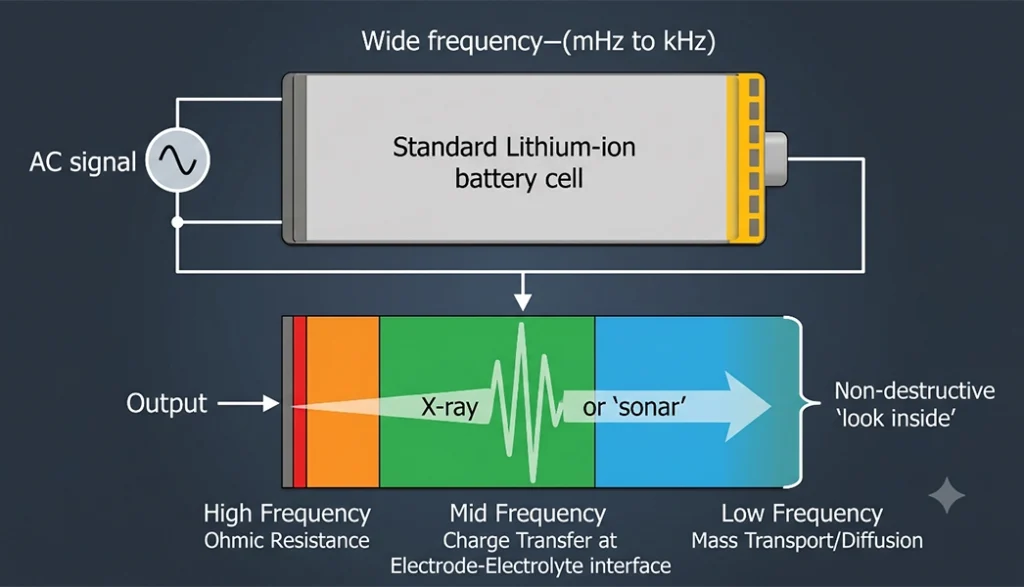
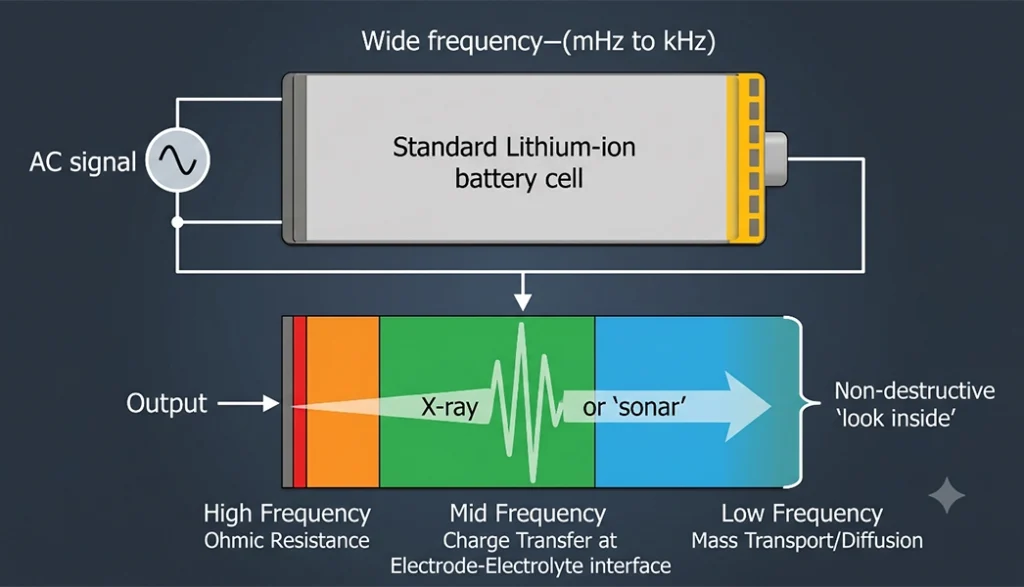
Electrochemical impedance spectroscopy applies a small electrical excitation and measures the battery’s response over a range of frequencies. The resulting impedance spectrum reflects several processes, including contributions from electronic resistance, ionic transport, charge-transfer reactions, and interfaces within the cell. Analysis may use equivalent-circuit models, characteristic features in the spectrum, or comparison with a validated reference dataset.
EIS can provide more diagnostic detail than a single load or voltage-recovery test. It can also be non-destructive and, with suitable equipment, may be used on batteries without dismantling them. These characteristics make it attractive for research, manufacturing quality control, service evaluation, and monitoring of batteries that must remain in operation.
The measurement is not automatically meaningful simply because it is made across many frequencies. Impedance changes with temperature, state of charge, rest time, current history, battery age, cell balancing, and the condition of electrical connections. Pack-level measurements may combine the behavior of multiple cells, interconnects, contactors, and measurement circuits. A reference spectrum from one battery model cannot necessarily be applied to another chemistry, design, capacity class, or generation.
A useful EIS system therefore requires controlled or recorded test conditions and reference data that match the batteries being evaluated. The reference population may need to account for normal manufacturing variation as well as different aging pathways. Results should be interpreted with other evidence, such as capacity, power capability, resistance, temperature, voltage behavior, and operating history.
EIS also does not automatically determine how much reserve energy a battery can deliver in a real application. An impedance feature may correlate with capacity or degradation for a defined population, but the relationship must be demonstrated under relevant operating conditions. Reserve-energy capability depends on the required load profile, allowable voltage limits, temperature, state of charge, and system controls. Where the consequence of failure is high, an EIS estimate should be supported by application-specific validation.
A practical comparison of the methods is:
| Method | Primary information | Main strengths | Important limitations |
|---|---|---|---|
| Load test | Voltage and current response under a defined load | Simple, direct indication of power delivery | Does not by itself establish total capacity or sustained runtime |
| Dynamic response | Voltage change and recovery after a load pulse | Can reveal time-dependent electrical behavior quickly | Sensitive to chemistry, temperature, state of charge, design, and degradation mode |
| Coulomb counting | Relative charge movement over time | Continuous and computationally simple | Requires a reliable starting condition and accumulates measurement error |
| Machine learning | Estimated state of health or capacity from multiple signals | Can combine BMS and operating-history data during normal use | Requires representative data, validation, and adequate data quality |
| EIS | Frequency-dependent electrochemical response | Can provide detailed, non-destructive diagnostic information | Requires suitable instrumentation, reference data, and controlled interpretation |
No single battery test is suitable for every application. Method selection should consider:
- battery chemistry and cell or pack design;
- whether the application prioritizes energy, power, or both;
- operating temperature and expected load profile;
- the required state of charge and test duration;
- available instrumentation and portability;
- operator training and data-interpretation capability;
- cost and the number of batteries to be assessed; and
- the decision that the result must support.
For a deep-cycle or backup system, usable capacity and the ability to sustain the required load may be the most important factors. For an engine-starting battery, high-current delivery and voltage stability may deserve greater weight. For an electric vehicle or stationary storage system, the assessment may need to combine capacity, power capability, resistance growth, thermal behavior, cell imbalance, and the recorded operating history.
Capacity remains a central measure because it indicates the amount of service the battery can provide over time. It should not be confused with state of charge. State of charge describes the approximate charge available at a particular moment, whereas capacity describes how much charge the aged battery can hold and deliver under specified conditions. A battery can be fully charged and still have substantially less capacity than it had when new.
Battery condition is often a critical failure point in equipment and infrastructure. A system may be maintained correctly in every other respect but still fail if its battery cannot deliver the required current or reserve energy. Service procedures can reduce this risk by including a battery test before equipment is returned to operation, especially after long storage, unusual thermal exposure, deep discharge, or an extended repair period.
Installed batteries also need attention after commissioning. Batteries in backup power, communications, industrial controls, renewable-energy systems, and other equipment may remain out of sight until a power interruption exposes a weakness. Periodic testing or continuous monitoring can identify changes before the battery becomes the immediate cause of an outage.
The acceptance decision should be tied to the application rather than to a generic health percentage. A useful question is whether the battery can still provide the minimum operational reserve required by the equipment. That reserve may mean enough energy to complete a controlled shutdown, maintain communications during an interruption, start an engine, support a critical load for a defined period, or reach a safe operating state. The required reserve is therefore application-specific and should be defined with its load, temperature, voltage, and duration conditions.
Cloud-connected analytics can support this process by collecting measurements from installed batteries, tracking trends, generating alarms, and helping schedule replacement before a predicted shortfall. Such systems may combine voltage, current, temperature, impedance, charge history, and event data. Trend information can be more useful than a single pass-or-fail result because it shows whether degradation is stable, accelerating, or associated with a particular operating condition.
Connected monitoring also introduces requirements. Sensors must be calibrated and maintained, data must be complete enough for the intended analysis, and communication links must be reliable. Cybersecurity, access control, software maintenance, and protection against incorrect alarms are part of the engineering design. A monitoring platform should not create a false sense of certainty when measurements are missing or when the battery operates outside the conditions represented by its diagnostic model.
The most transparent diagnostic practice is therefore a layered one. Use a simple test when it answers the operational question, add dynamic or continuous measurements when trends matter, and apply EIS or data-driven models when their reference data and limitations are understood. Combining complementary evidence gives service personnel and asset managers a better basis for deciding whether a battery should remain in service, receive further testing, be reused in a less demanding application, or be replaced.
References
- BU-917: In Search for Performance Transparency…. (n.d.). http://www.batteryuniversity.com/article/bu-917-in-search-for-performance-transparency-with-batteries
- The State of Health Estimation of Lithium-Ion Batteries: A Review of Health Indicators, Estimation Methods, Development Trends and Challenges. (n.d.). https://www.mdpi.com/2032-6653/16/8/429
- SOC estimation for a lithium-ion pouch cell using machine learning under different load profiles. (n.d.). https://pmc.ncbi.nlm.nih.gov/articles/PMC12103532
- State of Health (SOH) in Lithium Batteries: Comprehensive Guide to Degradation & Estimation. (n.d.). https://ewayenergy.com/state-of-health-soh-in-lithium-batteries-comprehensive-guide-to-degradation-estimation
- State of Charge Estimation of Lithium Ion Battery using Coulomb Counting Method in Electric Vehicle – IJERT. (n.d.). https://www.ijert.org/state-of-charge-estimation-of-lithium-ion-battery-using-coulomb-counting-method-in-electric-vehicle-ijertv15is100230
- Battery State of Health (SOH): What It Is and How to Measure It. (n.d.). https://battlebornbatteries.com/blogs/articles/battery-state-of-health-soh
- How do you test the health of a lithium-ion battery? | EL-CELL. (n.d.). https://www.el-cell.com/how-do-you-test-the-health-of-a-lithium-ion-battery
- SoC Estimation by Coulomb Counting - Battery Design. (n.d.). https://www.batterydesign.net/soc-estimation-by-coulomb-counting
- Step-by-Step Guide to Performing a Battery Load Test. (n.d.). https://www.large-battery.com/blog/battery-load-test-comprehensive-guide
- The Importance of Battery Testing. (n.d.). https://www.associatedenvironmentalsystems.com/blog/the-importance-of-battery-testing