A battery is a controlled source of electrical energy based on chemistry. Many natural and engineered processes can generate electricity: sunlight can be converted by photovoltaic materials, motion can be converted by generators, heat differences can drive thermoelectric devices, and chemical reactions can release energy through electron transfer. A battery belongs to the electrochemical group. It separates two reactions so that electrons are forced to travel through an external circuit rather than directly through the reacting materials.
That simple idea makes the battery unusually useful. It stores energy in a compact package, delivers it on demand, and can be scaled from a coin cell in a memory backup circuit to large battery systems used for backup power and grid support. The engineering challenge is not only to create voltage, but to do it safely, efficiently, repeatedly, and with predictable behavior under real loads.
The modern idea of a battery is strongly associated with Alessandro Volta. In 1800, Volta demonstrated the voltaic pile, an early electrochemical battery made from alternating zinc and copper elements separated by an electrolyte such as saltwater-soaked material. This was important because it produced a relatively steady electric current, unlike static electricity machines that were not practical continuous power sources. The unit of electric potential, the volt, is named in Volta’s honor.
Volta’s work also clarified a central principle: two different electrode materials in an electrolyte can create an electromotive force because each material has a different tendency to participate in electrochemical reactions. In a galvanic cell, the cell voltage is related to the difference between the electrode potentials of the two half-cell reactions. If the two electrodes are identical and are in the same electrolyte conditions, there is no useful net cell voltage from the electrode pair.
A kitchen lemon can demonstrate the same principle at a small scale. Insert a strip or nail of zinc and a piece of copper into the lemon without letting the metals touch. The lemon juice acts as an acidic electrolyte. Zinc has a stronger tendency to oxidize than copper in this arrangement, so the zinc electrode supplies electrons to the external circuit. The copper electrode provides the other terminal where reduction reactions can occur. Connect a high-impedance voltmeter across the zinc and copper and a small voltage can be observed.
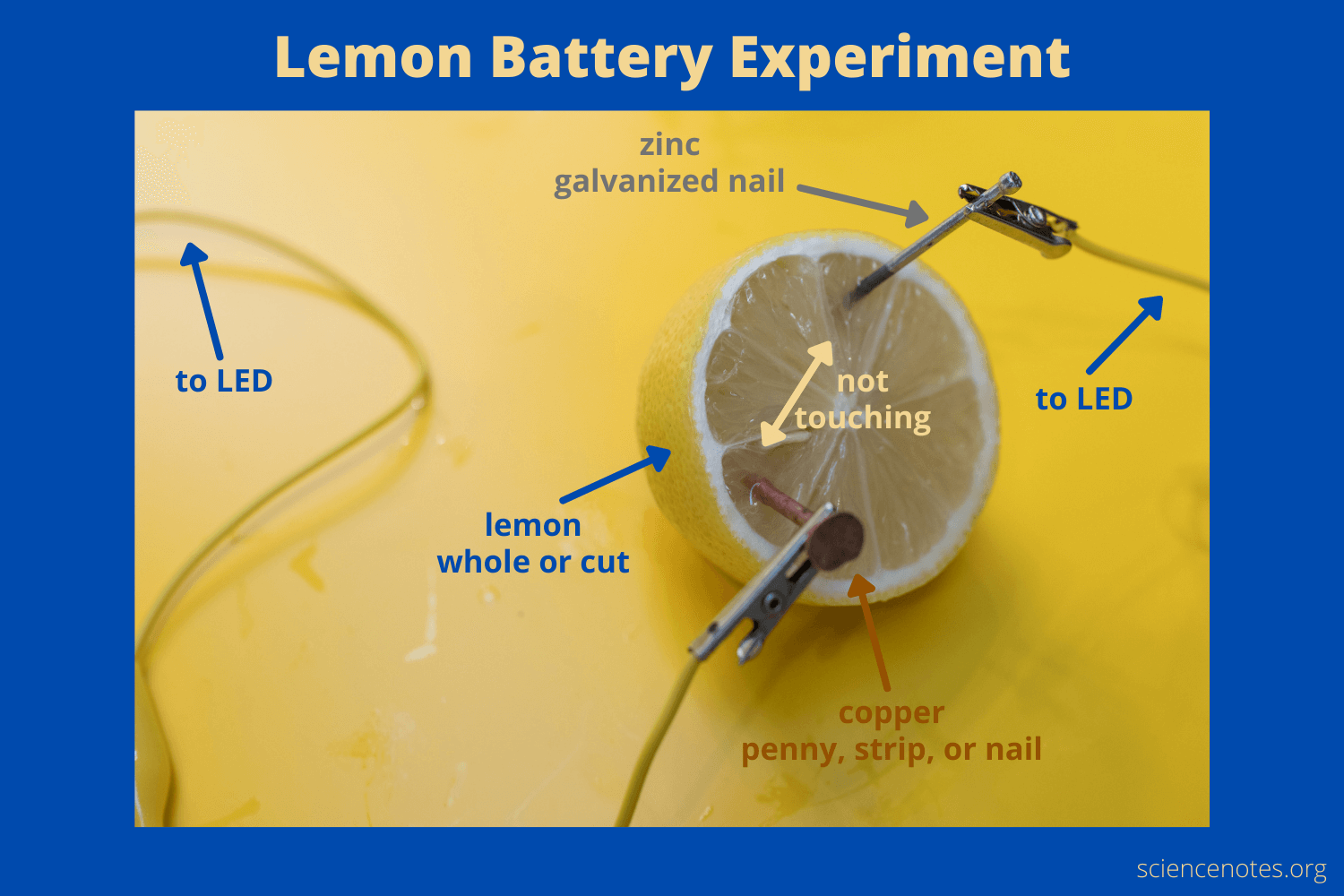
Source: Original source

The lemon cell is useful as a teaching model, but it is not a practical battery for powering equipment. Its internal resistance is high, its available current is low, and the chemistry is not packaged or controlled for useful service. Still, it shows the essential architecture of a cell:
- Negative electrode during discharge: the electrode that supplies electrons to the external circuit.
- Positive electrode during discharge: the electrode that accepts electrons through the external circuit.
- Electrolyte: an ion-conducting medium that completes the internal electrochemical path while not serving as a simple metal wire between the electrodes.
- External circuit: the path through which electrons perform useful work.
In a practical cell, the electrolyte may be liquid, gel-like, polymeric, or solid depending on the chemistry. The separator, current collectors, mechanical enclosure, venting strategy, seals, and protective electronics may be just as important as the active materials. The lemon example hides most of this engineering, but it captures the reason batteries have terminals and polarity.
The term standard potential refers to electrode potential measured under defined standard conditions. In engineering use, the concept is valuable because it explains why different material pairs produce different nominal cell voltages. It is not enough to say that a battery contains “chemicals”; the useful voltage comes from the difference in electrochemical potential between the two electrode reactions.
Standard potentials also explain why some material combinations are unsuitable or inefficient for a given application. A high theoretical voltage is not automatically a good battery. The chemistry must also be stable enough, conductive enough, manufacturable, safe within its operating limits, and compatible with the required life and cost. Electrochemistry gives the voltage opportunity; cell design determines whether that opportunity becomes a reliable product.
A primary battery is intended for one discharge life. A secondary battery is intended to be recharged. The difference is not simply whether a charger is connected. A rechargeable battery requires reactions that are sufficiently reversible: during charge, electrical energy must drive the discharge products back toward their charged state without excessive side reactions, damage, gas generation, heat, or loss of active material.
Reversibility is never perfect. Every rechargeable chemistry ages because some fraction of each cycle is consumed by parasitic reactions, mechanical changes, electrolyte decomposition, corrosion, loss of lithium inventory in lithium-ion cells, sulfation in lead-acid cells, or other chemistry-specific mechanisms. The useful question is not whether a cell is perfectly reversible, but whether it can repeat the charge-discharge process enough times, at the required rate and temperature, while remaining within acceptable safety and performance limits.
This is why primary and rechargeable cells often serve different roles. A primary cell can be optimized for long shelf life, low self-discharge, simple user replacement, or high energy in a one-time package. A rechargeable cell is chosen when repeated use justifies a charger, charge-control method, and aging management. Portable electronics, power tools, electric vehicles, and stationary storage depend on rechargeable batteries because repeated energy throughput is central to their economics and usability.
Electrical power is measured in watts. One watt is the rate at which energy is transferred or converted. In a DC circuit, power is commonly calculated as:
Power (W) = Voltage (V) × Current (A)
Energy is power accumulated over time. A watt-hour is the energy delivered by one watt for one hour. Battery energy is therefore often expressed in watt-hours:
Energy (Wh) = Voltage (V) × Capacity (Ah)
This distinction between power and energy is one of the most important battery concepts. A battery can have a large amount of stored energy but be unable to deliver it quickly. Another battery can deliver high current for a short time but store relatively little total energy. These are different design targets.
A bicycle analogy is useful. The rider’s total available food energy is like the battery’s stored energy. The rider’s momentary effort climbing a hill or sprinting is like power. A rider may have enough energy for a long trip at moderate pace but not enough power for a steep sprint. Another rider may deliver a very high burst of power but tire quickly. Batteries behave in a similar way: runtime and peak-load ability are related, but they are not the same specification.
This difference appears clearly in battery ratings. A small device such as a remote sensor may need very little power for a long time, so energy and self-discharge dominate the design. A starter battery for an engine must deliver very high current for a short interval, so power capability and low-temperature current delivery matter. Large energy-storage systems must balance energy capacity, power electronics limits, thermal management, lifetime, and safety.
The ampere-hour rating is a common battery capacity specification. It states how much charge a battery can deliver under specified test conditions. In simple terms, a 1 Ah rating means one ampere for one hour in the defined test, or an equivalent amount of charge at another current, subject to the limits of the cell. In practice, capacity depends on discharge current, cutoff voltage, temperature, cell age, and the manufacturer’s test method.
Ampere-hours alone do not tell the full energy content because they do not include voltage. A 2 Ah cell at a low voltage stores less energy than a 2 Ah cell at a higher voltage, assuming both can use the stated capacity over their working voltage range. For comparing batteries across chemistries or pack voltages, watt-hours are usually more meaningful than ampere-hours.
For example, a battery pack label may include nominal voltage and ampere-hours. Multiplying the two gives an approximate watt-hour value. This is an engineering estimate based on nominal voltage; exact delivered energy depends on the discharge curve and operating conditions. The result is still useful for comparing runtime between packs of similar design and chemistry.
Common rating terms describe different aspects of battery behavior:
| Term | Unit | What it describes | Practical use |
|---|---|---|---|
| Voltage | V | Electrical potential difference between terminals | Determines compatibility with loads and chargers |
| Current | A | Rate of charge flow | Indicates load or charge rate |
| Capacity | Ah or mAh | Charge available under specified conditions | Useful within the same voltage class |
| Energy | Wh | Voltage multiplied by capacity over time | Better for comparing runtime across voltages |
| Specific energy | Wh/kg | Energy stored per unit mass | Important where weight limits runtime or range |
| Energy density | Wh/L | Energy stored per unit volume | Important where space is limited |
| Specific power | W/kg | Power capability per unit mass | Important for acceleration, tools, and pulse loads |
| Power density | W/L | Power capability per unit volume | Important where compact high-power delivery is needed |
Specific energy and energy density are often confused. Specific energy is gravimetric: watt-hours per kilogram. Energy density is volumetric: watt-hours per liter. A handheld device designer may care strongly about volume because the battery must fit inside a thin enclosure. An electric vehicle designer cares about both volume and mass because battery weight affects efficiency, structure, and handling.
Specific power and power density describe how quickly energy can be delivered relative to mass or volume. High specific energy does not guarantee high power. A cell built for long runtime at moderate load may use electrode designs that store a large amount of energy but are not optimized for high current. A high-power cell may use thinner electrodes, lower internal resistance, and more robust current paths, but those choices can reduce the amount of energy stored in the same size or mass.
Consumer and industrial battery use illustrates the tradeoff. Consumer products often emphasize compact size, low cost, adequate runtime, and convenience. Examples include phones, laptops, cameras, household alkaline cells, and rechargeable packs for portable tools. Industrial batteries may place more emphasis on environmental ruggedness, specified operating temperature range, pulse-current capability, long calendar life, serviceability, traceability, or integration with monitoring and safety systems.
The same broad chemistry name does not guarantee the same performance. Lithium-ion, for example, is a family of rechargeable systems with different electrode materials, formats, operating limits, and protection requirements. A cell selected for a consumer device may not be suitable for a harsh industrial environment. Conversely, an industrial cell with conservative specifications may be larger or more expensive than necessary for a short-life consumer product.
Battery ratings must therefore be read as a set, not as isolated numbers. Voltage tells whether the battery can interface with the system. Ampere-hours suggest charge capacity. Watt-hours estimate stored energy. Maximum current, pulse-current limits, charge limits, temperature range, cycle life conditions, and safety approvals define whether the battery can actually do the job. A technically correct selection considers all of these constraints together.
It is also important to distinguish open-circuit voltage from loaded performance. A battery may show acceptable terminal voltage with no load but sag when current is drawn because of internal resistance, low temperature, aging, or depletion. The load converts electrical energy into work or heat, and the battery itself also dissipates some energy internally. This is why practical testing is performed under representative load conditions rather than by voltage measurement alone.
Charging adds another layer of control. A rechargeable battery should only be charged according to the method specified for its chemistry and pack design. Applying the wrong charger, exceeding voltage or current limits, charging outside allowed temperature range, or bypassing protection circuits can cause accelerated aging or unsafe behavior. The basic electrochemical idea is simple; safe rechargeable operation is not.
A battery, then, is best understood as an electrochemical energy system with measurable voltage, current, power, and energy behavior. Volta’s zinc-copper experiments showed that dissimilar materials in an electrolyte can produce a steady current. The lemon cell demonstrates the same principle at a classroom scale. Modern batteries refine that principle with controlled materials, separators, packaging, and electronics so they can serve predictable roles in portable, industrial, vehicle, and stationary applications.
The practical lesson is to match the rating to the question being asked. Use volts for electrical compatibility, amperes for load current, ampere-hours for charge capacity within a known voltage class, watt-hours for stored energy, and Wh/kg or Wh/L when weight or volume matters. For rechargeable systems, add reversibility, cycle life, operating conditions, and safety limits. Those combined factors define what a battery can do more accurately than any single number on its label.
References
- Battery University | BU-105: Battery Definitions and what they mean
- BU-104: Getting to Know the Battery
- Alessandro Volta - Wikipedia
- History of the Battery (What Should You Know)
- Zinc was isolated as a pure metal in the 1700s, and Volta …
- Euclid
- Volta created the Voltaic Pile, the world’s first true battery.
- What Is a Battery? Types, Components, and How Batteries Work | Technology Networks
- How do consumer and industrial Li batteries differ? - Battery Power Tips
- Volta Invents the Battery | History | Research Starters | EBSCO Research