The battery market is no longer defined mainly by portable electronics and automotive starter batteries. Those applications remain large, but the growth center has shifted toward rechargeable batteries for electric vehicles, stationary energy storage, industrial equipment, telecom backup, and high-volume consumer devices.
Older market references projected world demand for primary and secondary batteries to rise at about 8.1% per year to roughly USD 156 billion in 2024. Current market estimates still place the 2024 global battery market near that order of magnitude, but forecasts now diverge widely depending on whether the scope includes cells only, packs, battery systems, stationary projects, motive batteries, or broader battery technology categories. Recent market research cited in the supplied source set estimates about USD 139.9–140 billion in 2024, with forecasts ranging from about USD 450 billion by 2035 to about USD 672.5 billion by 2034.
The spread between these forecasts is not just a statistical detail. It reflects different assumptions about electric-vehicle adoption, lithium-ion average selling prices, regional manufacturing expansion, stationary storage deployment, and how traditional lead acid and primary battery sales are counted. For engineering and procurement work, the useful conclusion is that battery demand is growing rapidly, but chemistry mix, supply risk, and application requirements matter more than a single headline market number.
Rechargeable batteries dominate the market. The older Frost & Sullivan figure used in the reference article put secondary batteries at 76.4% of the global market, with an expected increase over time. A later 2019 market overview cited secondary batteries at 73.8%, while one 2024 estimate gives secondary batteries about 78.2% of the total market. The exact share varies by methodology, but the direction is clear: rechargeable systems are the main commercial battleground.
Electric vehicles are a major reason. The reference article noted that early EV demand expectations had been adjusted downward at the time. Since then, EV battery demand has become a central driver of lithium-ion manufacturing scale, chemistry selection, and raw-material planning. Automotive batteries are also reported as the largest end-use segment in some current market estimates, while Asia-Pacific remains the dominant regional production and consumption center, with supplied estimates around the mid-to-high 40% range of global market share or growth contribution.
An Overview of Battery Types
Battery markets are best understood by separating primary batteries from secondary batteries.
Primary batteries are not designed for routine recharging. They remain important in low-drain devices, emergency equipment, remote sensors, medical devices, and consumer products where long shelf life and simple replacement are more valuable than rechargeability. Alkaline cells are the largest familiar example in this category. Zinc-carbon cells persist in low-cost applications but have declined because alkaline batteries offer better specific energy and storage characteristics for most consumer uses.
Secondary batteries are rechargeable and now form the majority of global battery revenue. They include lithium-ion, lead acid, nickel-metal-hydride, nickel-cadmium, flow batteries, sodium-ion, and emerging solid-state or lithium-metal designs. In practice, most present revenue and installed capacity is concentrated in lithium-ion and lead acid.
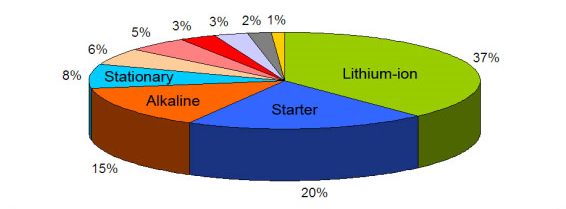
The original Battery University reference used a Frost & Sullivan 2009 revenue breakdown that is still useful historically because it shows how diverse the battery market was before today’s EV-driven lithium-ion scale-up:
| Battery type or application group | Historical revenue share in reference source | Main application context |
|---|---|---|
| Lithium-ion | 37% | Portable electronics, later expanding strongly into EVs and storage |
| Lead acid, starter battery | 20% | Automotive SLI batteries |
| Alkaline primary | 15% | Consumer replaceable cells |
| Lead acid, stationary | 8% | Backup power, telecom, UPS and standby service |
| Zinc-carbon primary | 6% | Low-cost disposable cells |
| Lead acid, deep-cycle | 5% | Golf cars, wheelchairs, scissor lifts and mobility equipment |
| Nickel-metal-hydride | 3% | Hybrid vehicles and legacy portable applications |
| Lithium primary | 3% | Long-life primary cells and specialty devices |
| Nickel-cadmium | 2% | Legacy industrial and portable uses |
| Other | 1% | Smaller chemistries and niche systems |
Source: Original source
Those percentages should not be applied directly to the present market. Lithium-ion has gained share because of EV packs, consumer electronics, power tools, and stationary storage. Lead acid remains large because it is inexpensive, robust, recyclable through established channels, and well matched to many standby and SLI duties. Primary batteries continue to sell in high volume, but they do not drive the same revenue growth as rechargeable automotive and grid-storage systems.
Lead acid batteries remain commercially resilient despite lower specific energy than lithium-ion. Their main market segments align with the reference article:
- SLI batteries for starting, lighting, and ignition in internal-combustion vehicles.
- Stationary backup batteries for UPS systems, telecom power, switchgear, emergency lighting, and standby power.
- Deep-cycle lead acid batteries for wheeled mobility, golf cars, wheelchairs, scissor lifts, floor-cleaning machines, and similar cyclic service.
Lead acid’s advantages are cost, surge-current capability, tolerance of abuse relative to many chemistries, and mature recycling infrastructure. Its disadvantages are mass, limited cycle life under deep discharge, sulfation sensitivity, lower energy density, and poorer suitability for high-range EV traction packs.
Lithium-ion batteries are the main growth chemistry. They are used across phones, tablets, laptops, power tools, e-bikes, EVs, battery-electric buses, residential storage, utility storage, and industrial battery systems. Lithium-ion is not a single chemistry; it includes LFP, NMC, NCA, LCO, LMO, LTO and blended variants. The correct choice depends on required energy density, power, thermal behavior, cost, charging profile, service life, and safety case.
LFP, or lithium iron phosphate, has grown quickly because it avoids cobalt and nickel, generally has favorable thermal stability compared with high-nickel layered oxides, and can deliver lower cost where pack volume and mass are acceptable. One supplied secondary-market source reports that LFP served about 40% of global EV demand in 2024. The same source also notes industry examples such as BYD’s Blade Battery at about 140 Wh/kg at pack level and pilot-cell claims for CATL’s M3P chemistry. These figures should be interpreted in their stated context: pack-level values, pilot cells, and commercial cells are not interchangeable.
Alkaline batteries remain important in primary consumer markets. They displaced much of the older zinc-carbon demand because they provide better practical energy and shelf life for many common loads. However, alkaline growth is structurally limited where devices migrate to built-in rechargeable lithium-ion packs or USB-rechargeable formats.
Zinc-carbon batteries continue to decline in many markets. Their cost can be attractive, but their performance is weaker than alkaline cells in most modern consumer applications.
Nickel-metal-hydride batteries still have practical roles, especially where robustness, moderate energy density, and established charging systems are useful. NiMH was historically important in hybrid vehicles and in applications that replaced nickel-cadmium. The reference article noted NiMH at about 3% market share and declining; a later market overview groups nickel-based batteries at only a small fraction of the rechargeable market. NiMH is not obsolete, but it is no longer a primary growth chemistry.
Nickel-cadmium batteries have continued to decline because cadmium is toxic and regulated. NiCd cells can be rugged and tolerate demanding industrial use, but environmental restrictions, recycling obligations, and substitution by NiMH and lithium-ion have reduced their role.
Lithium primary batteries are separate from lithium-ion rechargeables. They are used where long shelf life, wide temperature tolerance, and low self-discharge are important, such as meters, memory backup, remote sensors, military equipment, and some medical or industrial devices. They are not normally selected for high-cycle rechargeable service.
For system designers, the battery market can therefore be simplified into application families:
- Disposable consumer power: alkaline, zinc-carbon, and lithium primary.
- Low-cost standby and engine starting: flooded, AGM, and gel lead acid.
- High-volume rechargeable electronics: lithium-ion, historically with some NiMH.
- EV traction and high-growth motive power: lithium-ion, with LFP and high-nickel variants competing by use case.
- Stationary storage: lithium-ion, lead acid in legacy and cost-sensitive systems, and specialized systems such as flow batteries where duration and cycle economics justify them.
Advancements in Batteries
Battery development is driven by several engineering targets that often conflict with each other:
- Higher specific energy for longer runtime or driving range.
- Higher specific power for acceleration, fast charging, tools, and pulse loads.
- Lower cost per kilowatt-hour.
- Longer cycle life and calendar life.
- Wider temperature operating range.
- Reduced fire and thermal-runaway risk.
- Lower dependence on constrained or controversial materials.
- Easier manufacturing, testing, transport, reuse, and recycling.
No chemistry optimizes all of these at once. A battery that improves specific energy may require more difficult safety controls. A chemistry with excellent thermal stability may have lower voltage or lower energy density. A low-cost chemistry may require larger packs, different power electronics, or more mass.
Lithium-ion improvements have been incremental but commercially powerful. Cell makers improve cathode composition, anode design, electrolyte additives, separators, tab geometry, formation processes, current collectors, module architecture, thermal interfaces, and battery-management software. These changes can increase usable energy and life without changing the public chemistry name.
LFP adoption is one of the most important current trends. Its lower material cost and favorable safety characteristics make it attractive for standard-range EVs, buses, fleet vehicles, residential storage, and utility storage. In applications where volume is less constrained than in premium long-range EVs, LFP can be the more practical system choice.
High-nickel lithium-ion chemistries, such as NMC and NCA variants, remain important where high energy density is required. They can reduce pack mass and volume, but they require careful thermal, electrical, and manufacturing control. The market split between LFP and high-nickel chemistries is therefore not simply a matter of which chemistry is “better”; it is a trade-off between cost, range, packaging, safety strategy, raw-material exposure, and application duty cycle.
Lithium-metal batteries are a high-energy development path because metallic lithium can, in principle, provide much higher anode capacity than graphite. The attraction is straightforward: replacing or reducing graphite with lithium metal could increase cell specific energy and reduce cell volume for a given stored energy.
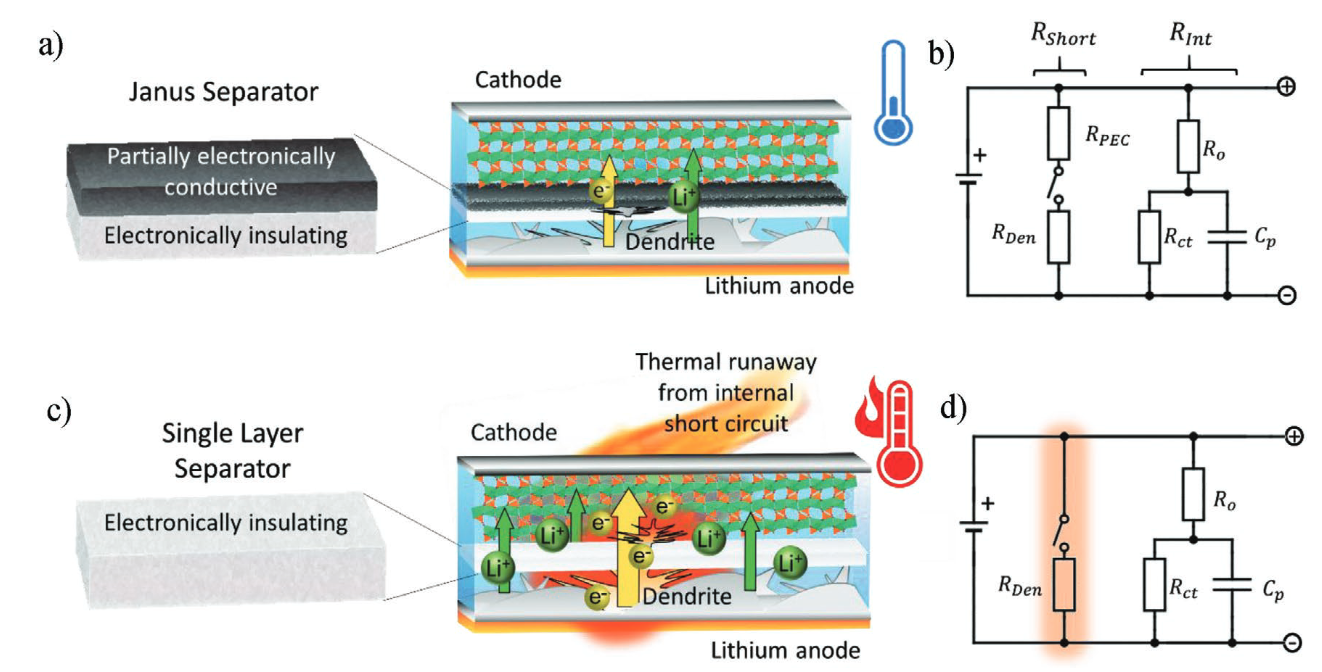
The technical barriers are also significant. Lithium metal can form dendrites during cycling. Dendrites may consume electrolyte, isolate active lithium, reduce cycle life, and in severe cases penetrate a separator and create an internal short circuit. Lithium metal is also reactive, which complicates safety, electrolyte selection, manufacturing atmosphere, formation protocols, and quality control. For this reason, lithium-metal results must be described carefully. Laboratory cells, small-format prototypes, pilot cells, and qualified commercial products are different maturity levels.
Source: Original source

Solid-state battery concepts often overlap with lithium-metal development. A solid or semi-solid electrolyte may help suppress dendrite growth, improve thermal behavior, or allow different electrode pairings. However, solid-state designs still face practical problems: interfacial resistance, mechanical contact during cycling, manufacturability, stack pressure, defect control, low-temperature behavior, and cost. Claims of high specific energy are meaningful only when accompanied by cell size, test conditions, cycle count, temperature, pressure, charge rate, and safety data.
Silicon anodes are another practical development area. Silicon can store more lithium than graphite by mass, but it expands significantly during lithiation. That expansion can crack particles, damage the electrode structure, consume electrolyte, and increase impedance. Commercial approaches often use silicon blends or engineered silicon-carbon structures rather than pure silicon anodes. The goal is to gain energy density without sacrificing cycle life or manufacturing yield.
Graphene and advanced carbon materials are frequently discussed as battery enhancers. Their practical value is not magic energy storage; it is usually related to conductivity, mechanical support, thermal pathways, surface area control, or improved electrode architecture. Graphene-like materials may help power capability or cycle stability in some designs, but performance claims depend strongly on loading, electrode thickness, binder system, electrolyte, and test protocol.
Sodium-ion batteries are relevant because sodium is widely available and may reduce dependence on lithium in some applications. Sodium-ion cells generally do not replace the highest-energy lithium-ion cells directly, but they may be attractive for cost-sensitive stationary storage, short-range mobility, and applications where lower energy density is acceptable. Their commercial value will depend on cycle life, low-temperature performance, supply chain scale, and pack-level cost.
Flow batteries occupy a different part of the design space. They are not usually selected for compact vehicles or portable devices. Their advantage is potential scalability for stationary storage, where energy capacity can be increased by enlarging electrolyte tanks. They may be useful where long duration, high cycle count, and stationary installation footprints are acceptable. Their market share is still much smaller than lithium-ion and lead acid in the supplied market segmentation.
Across all advanced chemistries, safety claims require caution. Battery safety is not determined by chemistry alone. It depends on:
- Cell design and manufacturing quality.
- Separator integrity and shutdown behavior.
- Electrolyte flammability and gas generation.
- Mechanical protection against crush and penetration.
- Thermal propagation barriers at module and pack level.
- Battery-management limits for voltage, current, and temperature.
- Charger behavior and fault detection.
- Installation ventilation, spacing, fire detection, and maintenance.
A safer cell can be made unsafe by poor pack design. Conversely, a higher-risk chemistry can be managed in a carefully engineered system, although at additional cost and complexity.
The broad market direction is therefore clear but not uniform. Lithium-ion will continue to dominate growth where high energy density and manufacturing scale matter. Lead acid will remain important where low cost, high surge current, and established recycling outweigh mass and cycle-life limitations. Primary batteries will persist where shelf life and replacement simplicity matter. Nickel-based chemistries will remain smaller and more specialized. Emerging systems such as lithium-metal, solid-state, sodium-ion, silicon-rich anodes, graphene-enhanced electrodes, and flow batteries will expand only where they solve a real system-level problem at acceptable cost and safety risk.
References
- Battery University | BU-103: Global Battery Markets
- Battery Market Size, Share | CAGR of 17.0%
- Secondary Battery Market Growth Analysis - Size and Forecast 2026-2030 | Technavio
- Battery Market Size & Share Report, 2035
- Secondary Battery Market - Share, Size & Growth
- Battery Technology Market Size to Hit USD 256.08 Billion by 2034
- [Electric Vehicle EV] Battery Market Size, Share & Growth, …
- A Review on Battery Market Trends, Second-Life Reuse, and Recycling
- [Secondary Battery Market Size, Share | Growth Report 2034]
- [Battery Materials Market Size, Share | Industry Report 2032]