Multi-Model Electrochemical Impedance Spectroscopy (EIS) is a non-invasive method for assessing battery condition from electrical responses measured across multiple frequencies. Instead of reducing battery health to one internal-resistance value, the method compares the measured response with a reference matrix built from batteries of known condition and performance.
The intended result is a broader diagnostic view: estimated capacity, cranking capability, state of charge (SoC), abnormal conditions, and the minimum reserve needed for a particular duty. This approach is described for both lead-acid and lithium batteries. It is especially useful where a battery may still start an engine or accept charge but no longer provide enough energy for the complete operating mission.
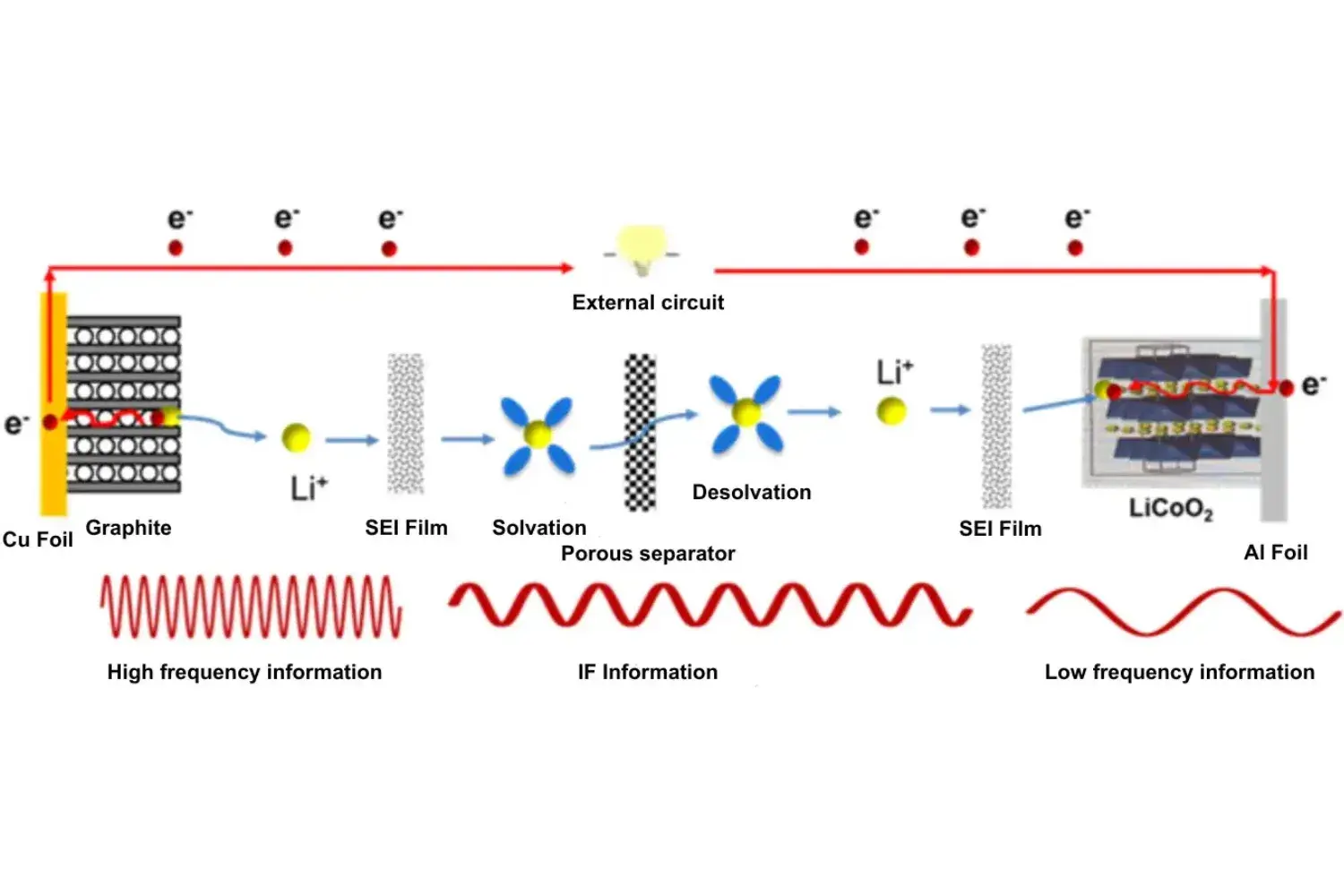
Source: Battery University
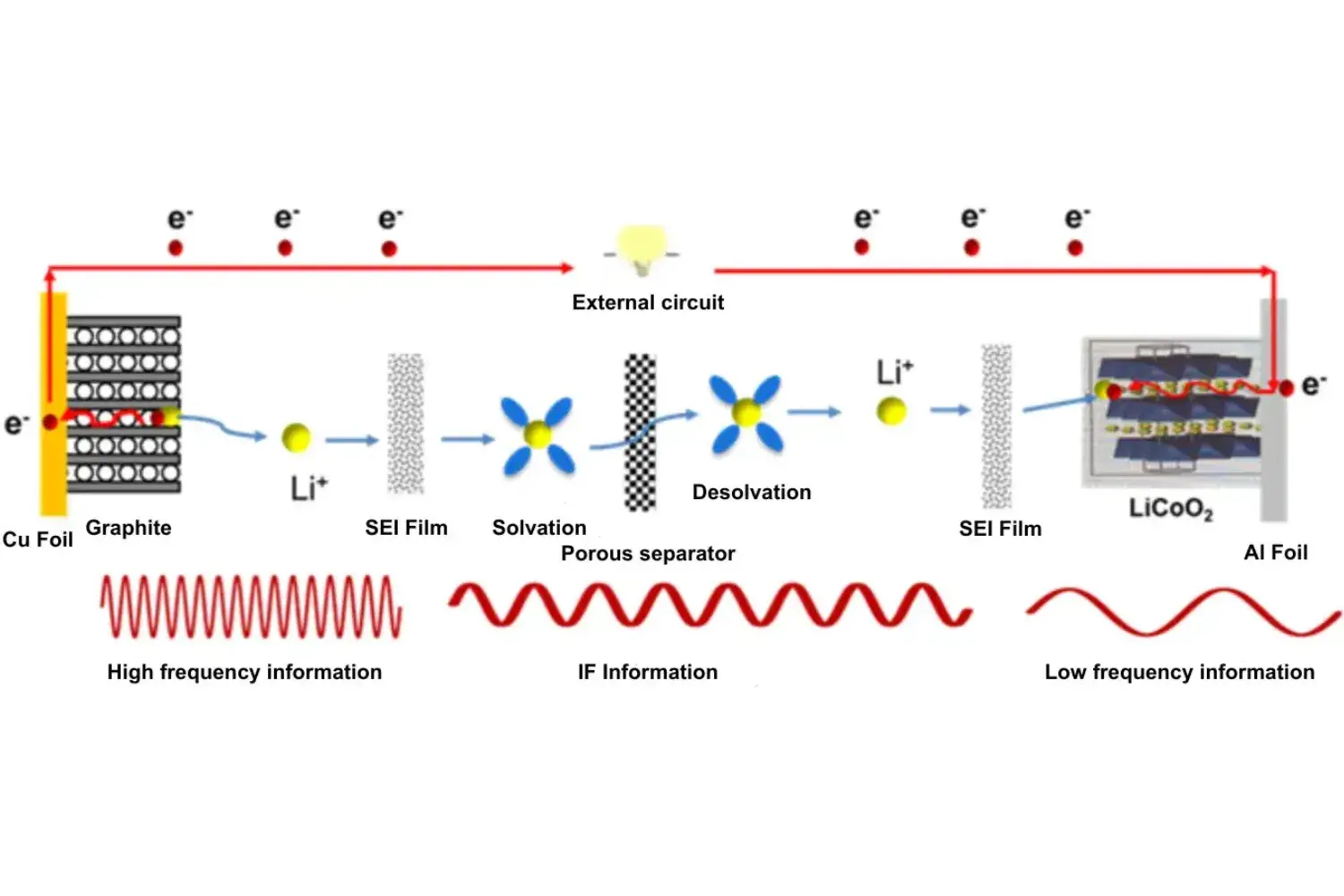
How Multi-Model EIS Assesses Battery Health
A conventional resistance or conductance test provides useful information about a battery’s ability to deliver current, but it does not fully describe usable energy. Capacity and cranking performance are related, yet they are not interchangeable. A battery can retain sufficient short-duration power for starting while having reduced capacity for accessories, repeated starts, or a longer backup interval.
Multi-Model EIS measures the battery response over more than one frequency and evaluates the resulting pattern against a reference matrix. The matrix represents how batteries of a defined type behave at different levels of health, charge, aging, or damage. The instrument then produces model-based estimates rather than treating one electrical measurement as a universal pass-or-fail limit.
The outputs can include:
- estimated remaining capacity;
- cranking or starting capability;
- state of charge;
- indications of abnormal or inconsistent behavior; and
- an estimate of the battery’s Minimum Operational Reserve Energy (MORE) for the intended application.
MORE is best treated as an operational decision concept rather than a chemistry-independent physical constant. It describes the reserve that must remain available for a mission or duty cycle. A bus, a passenger car, a lift, and a stationary backup system can therefore require different reserve thresholds even when their batteries have similar nominal ratings.
The supplied technical description states that the non-invasive scan can test lead-acid and lithium batteries up to 300 Ah and measure resistance down to 300 microohms. A typical test is described as taking about 30 seconds, with a longer duration when the scan extends to 0.1 Hz. Low-frequency measurements are associated with EIS Direct Drive, identified in the supplied material as technology offered in Spectro devices by Cadex. Actual capability remains dependent on the instrument, battery chemistry, test configuration, and supported matrix.
Unlike a direct discharge test, an EIS scan does not draw the full mission load from the battery. It is consequently suited to maintenance workflows in which removing a battery from service, fully discharging it, or waiting for a complete test would be impractical. Its estimates should still be interpreted within the limits of the applicable matrix and verified against installation condition, charging behavior, temperature, connections, and the battery manufacturer’s requirements.
Battery Matrices, Models, and Diagnostic Accuracy
A battery matrix is created by measuring a population of batteries whose condition or performance is known by other means. The samples may include batteries of the same or closely matching model at different stages of aging, charge, capacity loss, or fault development. Their electrical signatures are associated with reference results such as capacity or cranking performance.
When a new battery is tested, its measured response is compared with this population. The closer the battery and the matrix are in design, chemistry, construction, and operating context, the more meaningful the classification is likely to be. A matrix built for one battery family should not automatically be assumed to apply accurately to every battery with the same nominal voltage or Ah rating.
Different analytical methods can be used to convert the measured data into estimates. The reference material identifies several possibilities:
- Gaussian-process methods, which can model relationships and uncertainty in a measured population;
- neural networks, which can learn complex relationships from representative training data; and
- fuzzy logic, which can classify conditions using graded rules rather than rigid boundaries.
None of these methods is universally superior. Performance depends on the quality and coverage of the training data, the consistency of the measurements, the battery population, and the result being predicted. A model that performs well for capacity may not perform equally well for cranking capability, SoC, or a particular failure mode.
Matrix Integrity Level (MIL) is used as an indicator of how well the available matrix represents the battery population being tested. A strong integrity level implies that the matrix contains sufficiently relevant and representative data for the intended application. It does not mean that every individual result is exact, nor does it remove the need for physical inspection and engineering judgment. A battery outside the matrix’s chemistry, construction, age range, or operating conditions can reduce confidence in the estimate.
Matrix development is therefore an iterative process. Scans from matching battery models are combined with independent performance tests, and additional representative samples can improve classification across conditions that were previously underrepresented. Matrix libraries may then be distributed through connected services to compatible test instruments. Availability, subscription terms, supported chemistries, and data handling depend on the equipment and service in use; they should be confirmed with the current supplier rather than assumed from an older application description.
A related maintenance workflow is to retain test history for the individual battery. A QR code, serial number, asset tag, or similar identifier can associate successive measurements with the same battery. This allows technicians to review a trend rather than interpreting each test in isolation. The practical value depends on accurate identification, consistent test conditions, and clear policies for data ownership, retention, and access.
From Portable Rapid Testing to Battery History
A portable rapid tester applies the matrix-based approach at the vehicle or equipment level. Depending on its model and supported battery types, it can estimate capacity, cranking performance, SoC, and abnormal conditions without carrying out a long controlled discharge. The result is more informative than a starting-power check when the equipment depends on stored energy during operation.
Potential applications include:
- passenger vehicles and commercial vehicles;
- transit buses and other fleet vehicles;
- trucks and machinery;
- lifts and people movers; and
- floor-cleaning equipment and other wheeled machines.
In a passenger vehicle, the immediate question is often whether the battery can start the engine. In a lift, floor-cleaning machine, or people mover, the more important question may be how much working time remains before the battery reaches an unacceptable state. A battery can pass a short starting test while having insufficient capacity for a complete work period.
This distinction is important when selecting or interpreting a tester. Some instruments provide a model-based capacity estimate or classification; that is not the same as directly measuring capacity by fully discharging the battery under controlled conditions. The accuracy and meaning of the result depend on the battery matrix, test conditions, SoC, temperature, connections, and the instrument’s supported application.
Connected testing can extend the workflow beyond a single measurement. Compatible matrices may be updated or distributed through a cloud service, allowing field instruments to use application-specific data. A battery identifier can also connect each result to an asset record, making it possible to observe declining capacity, recurring low SoC, or changes after charging-system repairs.
Such records support condition-based maintenance, but they do not replace basic controls. The technician should confirm battery identity, inspect terminals and cables, check for swelling, leakage, corrosion, or physical damage, and consider whether the battery has recently been charged or deeply discharged. A result that conflicts with the equipment’s behavior should be investigated rather than accepted without question.
Using Reserve Energy to Make Maintenance Decisions
Many organizations know when a battery has failed but do not have a defined remaining-capacity threshold for removing it from service. This creates two opposing risks. Replacing batteries too early increases cost and labor, while keeping them in service beyond a useful reserve can produce an in-field failure, an interrupted work cycle, or an unsafe loss of mobility.
A reserve-based maintenance program begins by defining the mission. The relevant question is not simply whether the battery is new or whether it can deliver rated cranking current. It is whether enough energy remains for the required duty, including expected loads, duration, temperature, recovery opportunities, and the consequence of failure.
For wheeled mobility, a threshold near 60 percent of available capacity may be considered in some applications, but it is not a universal retirement limit. The appropriate value depends on the route, workload, battery type, charging schedule, backup equipment, and required margin. The unused charge at the end of a normal work period provides a practical feedback check: if a battery consistently finishes with much more reserve than expected, the threshold or operating plan may be conservative; if it finishes close to depletion, the reserve target may be too low.
This is similar to maintaining a fuel reserve for a vehicle: the operator does not plan to use every last unit of stored energy before reaching a safe stopping point. The analogy is only operational. Battery state of charge, remaining capacity, voltage behavior, and deliverable energy are affected by load, temperature, aging, and chemistry in ways that are not identical to a fuel tank level.
A load-bank discharge is a more direct way to assess usable capacity. It applies a defined load and records voltage and discharge behavior until the specified endpoint. The method can provide valuable confirmation, but it is slower, requires suitable equipment, may remove the battery from service, and can disrupt production or fleet availability. Non-invasive assessment is useful for screening and routine trending; direct discharge remains appropriate when a critical system requires a more definitive capacity test or when the applicable standard and manufacturer require it.
Hotel Load and Vehicle Reserve Requirements
Hotel load is the electrical demand from lights, displays, climate-related equipment, communications systems, and other accessories while a vehicle’s engine is switched off. Transit buses are a clear example: during a long stop, passengers and systems may still require power even though the alternator is not charging the battery.
The reserve requirement must cover both the duration of the stop and the energy needed to restart the engine. The supplied application examples describe a MORE of 50 percent for a regular bus and 65 percent for an articulated bus. They also cite 50 percent for long-distance trucks and armored vehicles and 40 percent for private cars. These figures should be treated as application examples from the source, not universal specifications or manufacturer-approved operating limits.
The meaning of each percentage must also be clarified before it is used in a maintenance procedure. It may refer to a remaining-capacity or reserve classification, state of charge under defined conditions, or a proprietary MORE value. It should not be copied into a fleet limit without confirming the instrument’s definition, the battery population, the load profile, and the equipment manufacturer’s requirements. The source also identifies approximately 30 percent as a minimum capacity associated with engine starting; starting demand, temperature, battery design, and test conditions can change the practical result.
Heavy commercial and specialty vehicles may need more reserve than private cars because they can carry larger accessory loads, remain stopped longer, operate in severe climates, or have fewer recovery options. A private car may tolerate a lower reserve for a short period without immediate stranding, but that does not make a 40 percent value suitable for every vehicle. Battery size, accessory load, route, starting demand, charging recovery, and the consequences of failure all matter.
Cranking checks answer a different question from capacity tests. A vehicle that starts normally may still have reduced energy reserve for hotel loads, repeated starts, extended parking, or an emergency operating period. Conversely, a low SoC or poor connection can affect a cranking result without proving that the battery has permanently lost capacity. Where the application warrants it, maintenance should combine cranking assessment, capacity or reserve estimation, SoC, and visual and electrical inspection.
Stationary backup batteries require the same distinction. The operator needs to know how long the system can support its load during a grid or supply interruption, not merely how old the battery is or whether its date label is current. Temperature, ventilation, maintenance, charging conditions, load profile, and installation environment all influence aging. Date-based replacement alone can therefore discard usable batteries or retain degraded ones.
A condition-based program should include capacity assessment and voltage-balance checks at an interval appropriate to system criticality. The supplied material cites six-month checks for stationary batteries, but the actual interval should follow the applicable standard, battery chemistry, manufacturer guidance, operating environment, and consequences of failure. Voltage balance may need to be reviewed at the cell, block, or module level, depending on the system design. Testing records should document the test method, operating conditions, abnormalities, and trend so that remaining runtime and replacement decisions are based on evidence rather than age alone.
References
- Battery University | BU-921: Testing Batteries by Multi-Model EIS. (n.d.). http://www.batteryuniversity.com/article/bu-921-testing-batteries-by-multi-model-eis
- Battery University | BU-901: Fundamentals in Battery Testing. (n.d.). http://www.batteryuniversity.com/article/bu-901-fundamentals-in-battery-testing
- How to Test Bus Battery Performance. (n.d.). https://buscmms.com/article/how-to-test-bus-battery-performance
- Limitations of Battery Conductance Testing. | BobIsTheOilGuy. (n.d.). https://bobistheoilguy.com/forums/threads/limitations-of-battery-conductance-testing.281267
- batteries - How to calculate remaining battery capacity from charge discharge data? - Electrical Engineering Stack Exchange. (n.d.). https://electronics.stackexchange.com/questions/441474/how-to-calculate-remaining-battery-capacity-from-charge-discharge-data
- How to Test Reserve Capacity of Battery. (n.d.). https://www.sunvoltbat.com/how-to-test-reserve-capacity-of-battery.html
- Transit Asset Management Performance Measure Targets ( .... (n.d.). https://www.transit.dot.gov/sites/fta.dot.gov/files/2023-08/2023%20A-90.pdf
- Expert Q&A: Best Battery Testers for CCA and How to Measure CCA. (n.d.). https://www.justanswer.com/home-improvement/77q5n-good-battery-tester-available-test-cca.html
- A Guide to Understanding Battery Specifications. (n.d.). https://web.mit.edu/evt/summary_battery_specifications.pdf
- How Electric School Bus Owners Can Maximize Battery Performance by Limiting Aging. (n.d.). https://electricschoolbusinitiative.org/how-electric-school-bus-owners-can-maximize-battery-performance-limiting-aging