A practical battery is more than stored charge. It must deliver runtime, supply current, remain affordable, survive years of use, operate safely, tolerate its environment, avoid excessive environmental harm, and recharge at a useful rate. Improving one requirement often weakens another, so selection is usually a trade-off, not a search for one best chemistry.
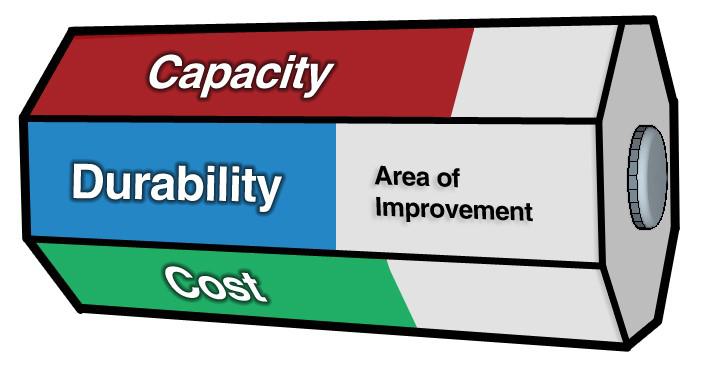
The “octagon battery” concept is a useful engineering checklist: a viable battery must satisfy eight requirements well enough for its application. A smartphone cell, power-tool pack, standby lead-acid system, electric vehicle pack, and grid-storage battery balance them differently.
Source: Original source

Specific Energy: Runtime and Weight
Specific energy is the amount of energy a battery stores per unit mass, normally expressed in watt-hours per kilogram (Wh/kg). It is one reason lithium-ion became dominant in phones, laptops, drones, e-bikes, and electric vehicles: more energy per kilogram means longer runtime or lower weight.
A common source of confusion is the difference between ampere-hour capacity and energy. Ampere-hours describe electric charge, not total stored energy. To compare cells correctly, voltage must be included:
- Energy in watt-hours = nominal voltage × ampere-hours
- Specific energy = watt-hours ÷ battery mass
This is why a 3 Ah lithium-ion cell and a 3 Ah nickel-metal-hydride cell are not equivalent energy devices. Lithium-ion cells typically operate at a higher nominal voltage, so the same ampere-hour rating can represent more energy.
Typical rechargeable battery families span broad ranges:
| Chemistry family | Typical specific energy range | Practical notes |
|---|---|---|
| Lead acid | about 30–50 Wh/kg in many designs | Low cost, mature, heavy |
| Nickel-cadmium | about 45–80 Wh/kg | Rugged but restricted in many consumer uses because of cadmium toxicity |
| Nickel-metal-hydride | about 60–120 Wh/kg | Used in some hybrid and consumer applications |
| Lithium-ion, cobalt/nickel-rich types | commonly higher; some commercial cells exceed 150 Wh/kg and advanced cells can be higher | Strong energy performance, requires careful protection |
| Lithium iron phosphate | often lower than high-nickel or cobalt-rich Li-ion | Favored where cycle life, cost, and safety matter |
Not all lithium-ion cells are designed for maximum energy. A cylindrical energy cell may prioritize high Wh/kg for long runtime, while a power cell in a similar package may sacrifice energy density to reduce resistance and deliver high current. Long-life traction or industrial cells may give up energy density for durability, thermal stability, or high cycle life.
The practical question is not “Which chemistry has the highest specific energy?” but “How much energy density can be used without compromising power, lifetime, safety, cost, or temperature requirements?”
Specific Power: Delivering High Current
Specific power is the ability to deliver power relative to battery mass, usually expressed in W/kg or kW/kg. A battery with high specific energy stores a lot of energy; a battery with high specific power releases energy quickly.
High specific power matters in applications such as:
- cordless drills, saws, and impact tools
- hybrid-vehicle launch assist and regenerative braking
- electric-vehicle acceleration
- uninterruptible power supplies with short high-load events
- aviation, robotics, and high-performance portable equipment
- cold-cranking or pulse-power loads
The trade-off is direct: cells optimized for high current commonly store less total energy than cells optimized for runtime. High-power cells use electrode designs, current collectors, separators, and internal geometries that reduce resistance and improve ion transport. Those choices can reduce active material available for energy storage.
Internal resistance is central. When current rises, heat generation rises approximately with the square of current. A cell intended for high power must control heat and avoid excessive voltage sag. Design factors include:
- electrode thickness and porosity
- conductive additives and current-collector design
- tab layout and cell format
- separator and electrolyte behavior
- thermal interface design at the pack level
- battery management limits for current, voltage, and temperature
Lithium-ion chemistry choice also matters. Lithium manganese oxide (LMO), lithium nickel manganese cobalt oxide (NMC), lithium iron phosphate (LFP), and lithium titanate (LTO) can all be configured for high-power service, but with different trade-offs. LTO is valued in niche systems for high power, long cycle life, and wide temperature capability, but it has lower energy density and higher cost than many graphite-anode lithium-ion systems.
A high-power battery is not simply a “stronger” battery. It is one whose electrochemical and mechanical design allows current to flow safely and repeatedly without unacceptable heat, voltage drop, or accelerated aging.
Cost: Making Batteries Affordable
Battery cost is shaped by raw materials, cell format, production volume, manufacturing yield, quality control, electronics, certification, packaging, logistics, and warranty risk.
High-volume production can reduce cost dramatically. Common phone, laptop, and cylindrical lithium-ion formats benefit from mature manufacturing lines, standardized components, and strong supply chains. A small custom pack can cost much more because engineering, testing, protection electronics, assembly labor, and documentation are spread across fewer units.
Cost drivers include:
- cathode and anode materials
- separator and electrolyte quality
- cell matching and grading
- welding, interconnects, and mechanical restraints
- protection circuits or a full battery management system
- thermal sensors, fuses, contactors, and current-limiting devices
- enclosure design, ingress protection, and ruggedization
- transportation compliance and product certification
Cell matching is especially important in multi-cell packs. Cells connected in series must age and charge consistently. Poor matching increases imbalance, reduces usable capacity, and can create safety or reliability problems. Tighter matching improves performance but adds sorting, testing, inventory complexity, and cost.
Purchase price is not lifecycle cost. Lead acid often has a lower upfront cost than lithium-ion in standby and backup applications, especially where weight and cycling are not critical. Lithium-ion can justify a higher initial price where lower weight, faster recharge, deeper cycling, reduced maintenance, or longer service life reduces total cost.
An affordable battery is application-specific. A low-cost chemistry can become expensive if it requires frequent replacement, oversized capacity, ventilation, maintenance, or heavy support structures. A high-cost chemistry can become economical if it reduces downtime, labor, weight, or energy losses.
Service Life: How Long the Battery Lasts
Battery service life has several meanings. A battery can fail because it loses capacity, develops high internal resistance, becomes imbalanced, fails safety checks, or reaches an end-of-life threshold defined by the equipment maker. In many engineering applications, end of life is defined when usable capacity falls to a specified fraction of original capacity, but the threshold depends on the application.
Two aging mechanisms are important:
- Cycle aging — wear caused by repeated charge and discharge.
- Calendar aging — degradation that occurs with time, even when the battery is not cycled heavily.
Factors that shorten service life include:
- high operating or storage temperature
- repeated deep discharge
- high charge or discharge C-rates
- overcharge or over-discharge
- long storage at high state of charge
- cell imbalance in series strings
- vibration, moisture, or mechanical damage
- poor charger control
Long life is especially important when the battery is large, expensive, or difficult to replace. Electric-vehicle packs, grid-storage systems, telecom backup banks, medical devices, aerospace systems, and industrial UPS installations cannot be treated like disposable consumer batteries.
Chemistry has a major influence. Lead-acid batteries can be reliable in float service but may suffer when deeply cycled unless designed for that duty. Nickel-cadmium is rugged and long-lived in some industrial uses, though environmental restrictions limit many applications. Nickel-metal-hydride can be durable but has higher self-discharge than lithium-ion. Within lithium-ion, LFP and LTO are often selected where long cycle life and abuse tolerance matter, while high-energy cobalt- or nickel-rich systems may trade some longevity for higher specific energy.
Pack design is just as important as cell chemistry. A well-designed battery management system, conservative voltage limits, good thermal control, and proper cell balancing can extend usable life. Conversely, a high-quality cell can have a short life in a pack with poor cooling or charge control.
Safety: Preventing Failure and Thermal Events
Battery safety is a system property. It depends on cell chemistry, separator integrity, electrolyte behavior, mechanical design, current interruption, pressure management, electronics, charger behavior, and user conditions.
Lithium-ion batteries store high energy in a compact package and normally use combustible organic electrolytes. Under abuse conditions—such as overcharge, short circuit, crush damage, excessive heat, manufacturing defects, or use outside specified limits—some cells can enter thermal runaway. Thermal runaway is a self-heating failure in which rising temperature accelerates internal reactions, potentially leading to venting, fire, or propagation to adjacent cells.
Reputable lithium-ion packs reduce these risks with layered controls:
- cell-level vents or pressure-relief features
- shutdown separators in some cell designs
- positive temperature coefficient or current-interrupt devices in some formats
- fuses and current limits
- voltage and temperature monitoring
- cell balancing
- charger communication
- mechanical spacing or barriers
- thermal management
- certification and abuse testing
Chemistry selection affects risk. LFP is widely regarded as one of the more thermally stable lithium-ion cathode systems and is often chosen for electric vehicles, stationary storage, and replacement of lead-acid batteries. LCO and some high-nickel chemistries can provide high energy density but require careful control. LTO systems can be robust in power and cycle-life applications, but lower energy density and higher cost limit use.
Safety history shows why meeting one target is not enough. Rechargeable systems that delivered attractive energy but could not control internal short circuits, overcharge behavior, or abuse response have been restricted, redesigned, or removed from markets. Isolated failures do not prove an entire chemistry is unsafe, but they show the importance of manufacturing quality, pack protection, and correct application limits.
All rechargeable chemistries require protection against misuse. Lead acid can vent hydrogen if improperly charged. Nickel-based cells can heat, vent, or suffer pressure rise under abusive charging. Lithium-ion demands especially disciplined protection because of its high energy density and sensitivity to overvoltage, undervoltage, and temperature extremes.
Operating Temperature Range
A battery must operate across the temperature conditions required by its application. Indoor consumer electronics face a much easier environment than automotive, outdoor telecom, industrial, aerospace, marine, or grid-storage equipment.
At low temperature, batteries usually show:
- reduced available capacity
- lower power capability
- higher internal resistance
- slower ion mobility
- poorer charge acceptance
- more voltage sag under load
The battery may not be empty, but cold conditions can prevent it from delivering energy at the required rate. This is common in winter vehicle operation, outdoor instruments, and emergency power equipment.
Charging in the cold is often more restrictive than discharging. Lithium-ion cells are especially sensitive to charging below freezing unless the cell, pack, and charger are specifically designed for cold charging. The main concern is lithium plating on the anode, which can reduce capacity and increase safety risk. Many packs block charging below a temperature threshold or use heaters to bring cells into an acceptable range.
High temperature creates different problems. It accelerates chemical aging, increases self-discharge, stresses separators and electrolytes, and can reduce safety margin. A battery stored hot and fully charged may lose capacity much faster than one stored cool at a moderate state of charge.
Some chemistries and designs suit wide operating ranges. LTO is known for strong low-temperature and high-power characteristics in specialized applications. LFP can be rugged and thermally stable, though cold charging still requires correct controls. Lead-acid batteries can operate in cold environments but lose power and charge acceptance at low temperature and age faster when hot.
Temperature range should be evaluated at the pack and system level, not only from a cell datasheet. Enclosure design, heating, cooling, current limits, insulation, ventilation, and BMS logic determine whether the battery can meet the real operating requirement.
Toxicity and Environmental Impact
Toxicity is a battery-selection criterion because batteries are manufactured, shipped, used, collected, recycled, and sometimes mishandled at end of life. Hazardous materials affect worker exposure, regulation, transport rules, recycling economics, and environmental release risk.
Nickel-cadmium illustrates the issue clearly. NiCd batteries are rugged and can perform well, but cadmium is toxic. Many consumer applications moved away from NiCd toward nickel-metal-hydride and lithium-ion chemistries to reduce hazardous-metal concerns and comply with restrictions.
Lead-acid batteries contain a large amount of lead, which is toxic and must be controlled. The chemistry remains widely used because it is mature, inexpensive, and supported by established collection and recycling systems. That infrastructure is essential; lead-acid batteries should not enter ordinary waste streams or uncontrolled recycling operations.
Rechargeable lithium-ion batteries are different from primary lithium-metal cells. They generally do not contain metallic lithium, lead, or cadmium. However, they can contain nickel, cobalt, manganese, copper, aluminum, graphite, electrolyte solvents, lithium salts, binders, plastics, and electronic components. These materials still require responsible handling and recycling.
Lithium-ion chemistry varies significantly:
- LFP avoids nickel and cobalt in the cathode and is often favored where cost, safety, and material concerns are important.
- NMC contains nickel, manganese, and cobalt and is widely used where energy and power balance is needed.
- NCA contains nickel, cobalt, and aluminum and is used in some high-energy applications.
- LCO contains cobalt and has been common in portable electronics.
- LMO uses manganese-based cathode material and is used in some power and medical applications.
Environmental impact is not only toxicity. Energy used in mining and manufacturing, pack lifetime, repairability, transport weight, recycling yield, and second-life use can change the overall footprint. A chemistry with lower hazardous content is not automatically the most sustainable if it fails early or cannot be economically recovered.
Fast Charging: Speed Versus Stress
Fast charging is usually discussed in terms of C-rate. A 1C charge rate charges a battery at a current numerically equal to its rated ampere-hour capacity. For example, a 5 Ah cell charged at 1C receives 5 A under the relevant charge-control profile. A 0.5C rate would be 2.5 A.
Safe charge rate depends on:
- chemistry
- cell design
- temperature
- age and state of health
- state of charge
- cell balance
- cooling capability
- charger accuracy
- BMS limits
General guidance is that lithium- and nickel-based rechargeable batteries are commonly charged at about 1C or slower unless specifically designed for higher rates. Nickel-based batteries can accept faster charging than lead acid when temperature and termination are properly controlled. Lead-acid batteries generally require much longer charge times and are not suited to aggressive fast charging in the same way.
Lithium-ion fast charging is most difficult at low temperature, high state of charge, and advanced age. At low temperature, lithium plating risk rises. Near full charge, cell voltage approaches its upper limit and current must taper. In aged cells, higher internal resistance creates more heat and increases imbalance risk.
Exceeding recommended charge rates can cause:
- excessive heat generation
- lithium plating in lithium-ion cells
- gas generation and pressure rise in some systems
- accelerated capacity loss
- increased internal resistance
- cell imbalance
- venting or safety shutdown
- thermal runaway risk under severe abuse
Modern fast charging is not just a larger charger. It requires compatible cell chemistry, thermal management, accurate voltage and current control, charger-to-pack communication, and BMS supervision. A pack designed for fast charging may use conservative voltage windows, active cooling, current tapering, and temperature-based charge limits.
Aged, damaged, or mismatched cells are poor candidates for fast charging. The more aggressively a battery is charged, the more important it becomes to verify cell condition, temperature uniformity, and balance. Fast charging is valuable, but it is always a managed compromise between convenience, lifetime, and safety.
References
- Battery University | BU-104c: The Octagon Battery – What makes a…
- Battery Comparison of Energy Density - Cylindrical and Prismatic Cells
- About Lithium-ion Batteries | Battery Council International
- Understanding Lithium Battery Types: A Guide for Portable Power Users | Outbound Power
- [PDF] Technical Comparison of Lead-Acid and Lithium-ion Batteries
- The Battery Basics: Understanding Lithium-Ion, Lead-Acid and More
- What are six key considerations when choosing a Li-ion …
- Lithium-Ion Battery - Clean Energy Institute - University of Washington
- A Guide To The 6 Main Types Of Lithium Batteries | Dragonfly Energy
- Understanding Lithium-Ion Battery Weight and Energy Density for Modern Devices