Repairing a battery pack usually means replacing one or more individual cells, or rebuilding the complete cell set inside the original enclosure. This can restore some power-tool, instrument, and commercial packs, but it is not a simple matter of installing cells with the same physical size. The replacement cells must match the original chemistry, voltage limits, current capability, dimensions, and pack-management system.
Cell availability also depends strongly on chemistry. Nickel-cadmium (NiCd) and nickel-metal hydride (NiMH) replacement cells have traditionally been available through battery-repair channels in several common sizes. Quality lithium-ion cells can be more difficult to source because reputable suppliers may qualify customers, sell through distribution channels, or impose minimum order quantities. This makes supplier traceability and pack design verification important before any repair begins.
Replacement Cell Availability and Sourcing
Some battery packs are practical candidates for repair because the cells are standard formats and the enclosure can be opened without destroying the wiring or protection system. A replacement may involve one defective cell, several cells, or the complete cell assembly.
NiCd and NiMH cells remain relatively straightforward to find for older tool and commercial packs. Lithium-ion cells are widely used, but reliable replacement sourcing is more demanding. The same nominal format, such as an 18650 cylindrical cell, can be sold in versions with very different capacity, discharge capability, construction quality, and intended application.
When sourcing lithium-ion cells, check for:
- A traceable manufacturer and part number.
- A datasheet or other manufacturer documentation.
- Ratings that are realistic for the cell’s size and application.
- A supplier with established battery-industry distribution.
- Consistent cell condition, labeling, and production information.
Some high-quality lithium-ion manufacturers primarily supply qualified pack manufacturers or authorized distributors rather than individual repair customers. Minimum-order requirements and distribution restrictions can therefore make small-quantity repairs difficult. A cell that is easy to purchase is not necessarily a cell that is suitable for a safety-critical or high-current pack.
Protection Circuitry and Pack Architecture
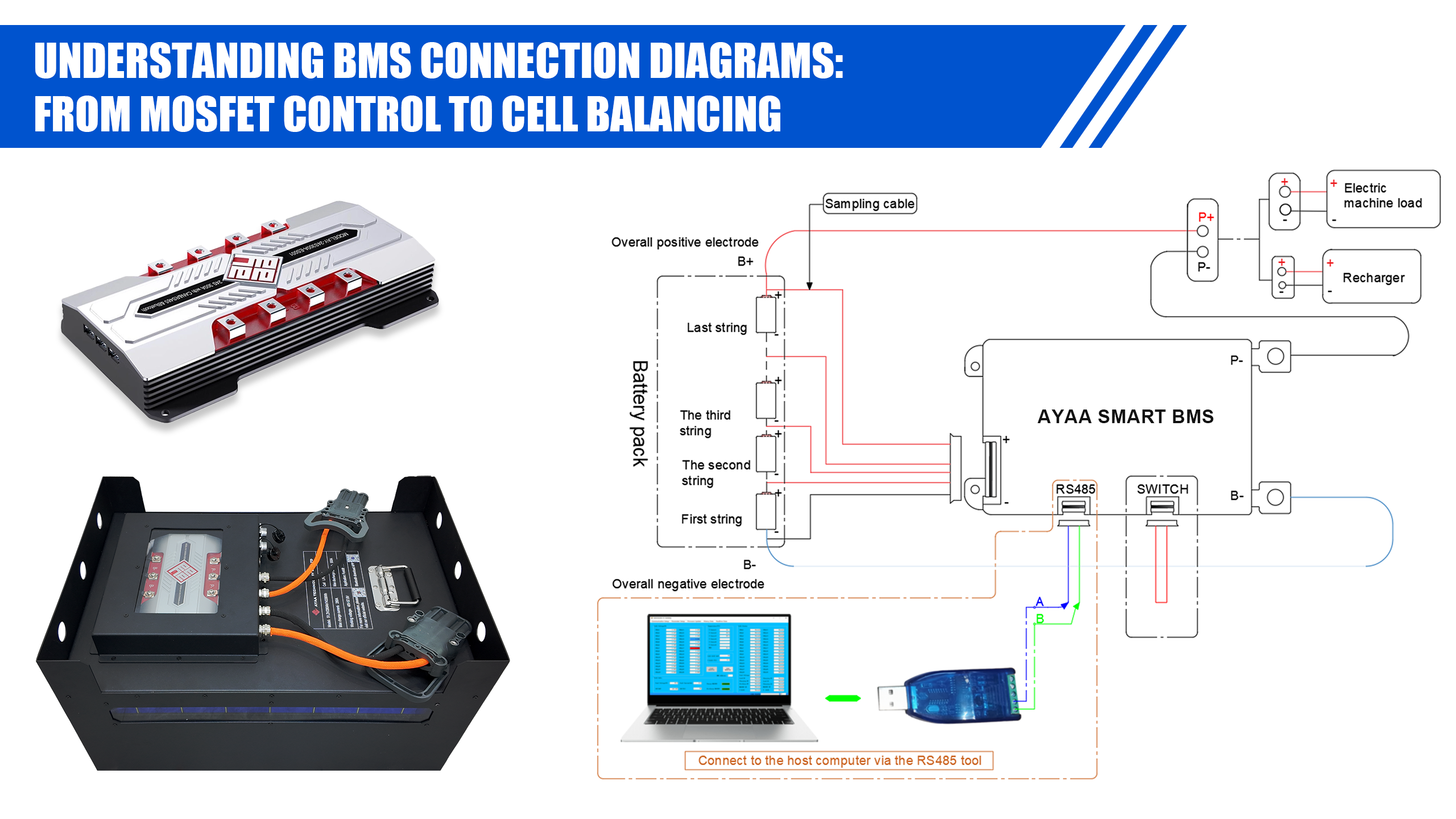
Before disconnecting cells, identify how the original pack is arranged and controlled. A pack may contain cells in series, parallel groups, or a combination of both. It may also include a protection board, a full battery-management system (BMS), temperature sensors, current-sensing components, balancing circuits, communication lines, or a fuse and cutoff device.
Lithium-ion cells must be reconnected to the protection and monitoring circuitry in the correct order and configuration. Depending on the design, the control system may monitor individual series-cell groups, pack voltage, current, and temperature. It may also balance cells during charging or disconnect the pack when voltage, current, or temperature moves outside permitted limits.
Not every battery chemistry uses the same control arrangement. Lead-acid batteries and nickel-based batteries have different charging behavior and safety requirements from lithium-ion systems. A simple single-cell product may use a small protection circuit, while a power-tool pack may include several series groups, temperature sensing, identification contacts, and electronic communication with the tool and charger.
Do not assume that a replacement BMS is interchangeable merely because its connector fits. The board must be compatible with the number of series groups, cell chemistry, voltage thresholds, current requirements, temperature-sensor arrangement, balancing method, and charger. Photographing and documenting the original wiring before disassembly can help, but it does not replace electrical verification.
Source: Battery University

A pack that has lost its original protection function should not be operated simply because the cells measure an acceptable voltage. Protection and monitoring are part of the pack’s safety architecture, not optional accessories.
Match Replacement Cells to Chemistry and Voltage Limits
Lead-acid and nickel-based battery systems are comparatively uniform within their respective families, but the lithium-ion family includes several chemistries with different voltage behavior. Lithium-ion cells that look similar may have different nominal voltages, full-charge limits, discharge limits, charge procedures, and thermal characteristics.
A conventional lithium-ion cell commonly has a nominal voltage in the mid-three-volt range and a manufacturer-defined full-charge limit around the familiar 4.2-volt class. Lithium iron phosphate (LFP) cells have a lower nominal voltage and a different full-charge limit. Lithium-titanate (LTO) cells have still different voltage characteristics and are designed around a lower-voltage operating window. These are representative distinctions, not universal values for every product.
The charger and protection system are designed around the original cell chemistry. Substituting an LFP or LTO cell into a pack designed for conventional lithium-ion cells can result in incorrect charging, inaccurate state-of-charge estimation, premature cutoff, poor capacity utilization, or unsafe overcharge conditions. The reverse substitution can create similar problems.
Match all of the following before selecting a replacement:
- Cell chemistry and manufacturer-specified voltage limits.
- Number of cells or parallel groups in the pack.
- Charger output and charging algorithm.
- Protection-board and BMS thresholds.
- Required capacity and discharge performance.
- Physical dimensions, terminals, insulation, and interconnect layout.
Do not select cells based only on nominal voltage printed on the label. The full-charge voltage, minimum operating voltage, charging method, and control-system settings are equally important.
Choose Cells for Energy, Power, and Mechanical Requirements
Cells are optimized for different jobs. Energy-oriented cells provide useful capacity and runtime at moderate current. Power-oriented cells are designed to deliver higher discharge current with less voltage sag and better control of heat under demanding loads. A high-capacity cell is not automatically a high-power cell.
Power-tool packs commonly experience high current during acceleration, cutting, drilling, or impact operation. Their replacement cells therefore need power specifications comparable to the original cells. Installing energy-oriented cells with insufficient discharge capability can cause excessive voltage drop, heating, protection cutoffs, or premature cell degradation.
Energy-oriented cells may be used in products such as cameras, communications equipment, and some e-bikes, but the application must be confirmed rather than assumed. Some e-bike packs combine substantial energy capacity with significant power demand and may use cells selected for both characteristics.
Compare the original and replacement cells for:
- Continuous and pulse discharge current.
- Recommended and maximum charge current.
- Rated capacity under the relevant test conditions.
- Internal resistance and expected voltage sag.
- Heat generation during charge and discharge.
- Cycle-life expectations for the application.
- Diameter, length, terminals, insulation, and mounting clearances.
Mechanical fit is a safety requirement as well as a packaging issue. Cells must not be forced into place, allowed to move, pinched by the enclosure, or exposed to abrasion from sharp edges. Interconnects should be suitable for the expected current and installed without creating shorts or excessive mechanical stress.
Avoid Counterfeit and Poor-Quality Replacement Cells
Price alone is a poor selection criterion. Cell quality can vary substantially even within a common format such as the 18650. The replacement market includes cells that may be rewrapped, recycled, used, counterfeit, incorrectly labeled, or advertised with capacity and current ratings that the cell cannot deliver.
Poor-quality or mismatched cells can cause rapid capacity loss, increasing imbalance, abnormal heating, premature pack failure, and unsafe operation. A pack assembled from cells with inconsistent capacity or impedance may appear to work initially while one cell repeatedly reaches a voltage limit before the others.
Useful checks include:
- Confirming the manufacturer’s identity and exact part number.
- Comparing markings with authentic manufacturer documentation.
- Purchasing through a traceable distributor.
- Measuring open-circuit voltage before assembly.
- Testing capacity under controlled conditions.
- Measuring or comparing internal resistance using an appropriate method.
- Checking cells for dents, torn insulation, corrosion, swelling, leakage, or other damage.
Capacity and resistance testing should be performed with equipment and procedures appropriate to the cell chemistry. A single voltage measurement cannot authenticate a cell or prove that it is healthy. Cells that fail inspection or show abnormal self-discharge should not be installed in a pack.
Replace One Cell or the Complete Cell Set?
Replacing one cell can be reasonable when the pack is relatively new, the fault is clearly isolated, the remaining cells are healthy, and a truly compatible replacement is available. The decision is more difficult in a series or parallel pack because cells share current and affect one another’s state of charge.
An aged pack is usually a better candidate for a complete cell-set replacement than for a single-cell repair. Mixing a new cell with older cells can produce differences in capacity, internal resistance, state of charge, and previous cycle history. These differences may increase imbalance and reduce the usable capacity of the rebuilt pack.
In a series string, the weakest cell or parallel group can reach the upper or lower voltage limit before the others. The BMS or charger must then stop charging or discharging, leaving energy in the stronger cells unavailable. In a parallel group, cells with different resistance or state of charge can exchange current unevenly, producing additional stress during connection and operation.
Use the weakest-cell concept when evaluating the pack: the practical performance of a series-connected battery is often limited by the cell or group with the least capacity or poorest power capability. Replacing only that cell does not guarantee a balanced pack if the remaining cells are already aged.
The final decision should consider:
- The pack’s series-parallel topology.
- The age and service history of the existing cells.
- Measured capacity and internal resistance.
- State of charge before cells are connected.
- Compatibility with the original BMS and charger.
- The cost and risk of repair compared with an approved replacement pack.
Battery-Pack Repair Safety and Quality Checklist
Battery-cell replacement can create fire, shock, chemical, and injury hazards. Professional repair requires suitable test equipment, controlled work practices, appropriate insulation, and a clear procedure for handling damaged or failed cells. Consumers should not open or rebuild a lithium-ion pack unless they have the necessary competence and equipment.
Use this checklist before returning a repaired pack to service:
- Match cells for chemistry, age, capacity, discharge capability, and other relevant electrical characteristics.
- Reproduce the original series-parallel arrangement and reconnect every sensing and protection lead correctly.
- Do not operate or charge a lithium-ion pack without the protection and individual-cell monitoring appropriate to its architecture.
- Retain suitable temperature sensing and a mechanism that interrupts current if unsafe heating occurs.
- Use the original or an approved compatible charger and a controlled initial charge procedure supported by the pack design.
- Monitor the pack during initial charging and stop if it becomes abnormally hot, swells, vents, smells unusual, or behaves unpredictably.
- Treat unknown-brand, damaged, rewrapped, or undocumented cells as unsuitable until their identity and condition are established.
- Never charge cells that are physically damaged, swollen, leaking, or severely over-discharged.
- Check the repaired pack for abnormal self-discharge after assembly and during an initial observation period.
- Keep the pack away from combustible materials during testing and charging, and follow local requirements for damaged-cell disposal.
A successful repair is not demonstrated only by the pack powering the device once. The pack must remain within its voltage, current, and temperature limits, charge correctly, maintain reasonable balance, and show no abnormal heating or self-discharge. If the original architecture cannot be identified or the cells have suffered physical damage, replacement by a qualified service provider is safer than experimental rebuilding.
References
- BU-910: How to Repair a Battery Pack. (n.d.). http://www.batteryuniversity.com/article/bu-910-how-to-repair-a-battery-pack
- Battery University | BU-409: Charging Lithium-ion. (n.d.). http://www.batteryuniversity.com/article/bu-409-charging-lithium-ion
- Battery University | BU-908: Battery Management System (BMS). (n.d.). http://www.batteryuniversity.com/article/bu-908-battery-management-system-bms
- Report: Lithium-ion battery safety. (n.d.). https://www.productsafety.gov.au/system/files/CSIRO-ACCCLithiumIonBatteries.pdf
- Lithium-Ion Battery Safety Guidance. (n.d.). https://ehs.mit.edu/wp-content/uploads/2019/09/Lithium_Battery_Safety_Guidance.pdf
- Battery Management System: Architecture & Functions. (n.d.). https://www.zetwerk.com/blog/bess/battery-management-system-architecture-functions
- Lithium-Ion Battery Risks | Sigma7 | Integrated Risk Management | Worldwide. (n.d.). https://www.s7risk.com/lithium-ion-batteries-risks
- Battery Management System Safety and Fault Management for Lithium Ion Batteries. (n.d.). https://www.youtube.com/watch?v=8eItvOuDRjw
- Individual Cell-Level Temperature Monitoring of a Lithium-Ion Battery Pack. (n.d.). https://www.mdpi.com/1424-8220/23/9/4306
- How to Charge a Lithium Ion Battery. (n.d.). https://www.keysight.com/used/us/en/knowledge/guides/how-to-charge-lithium-ion-battery